
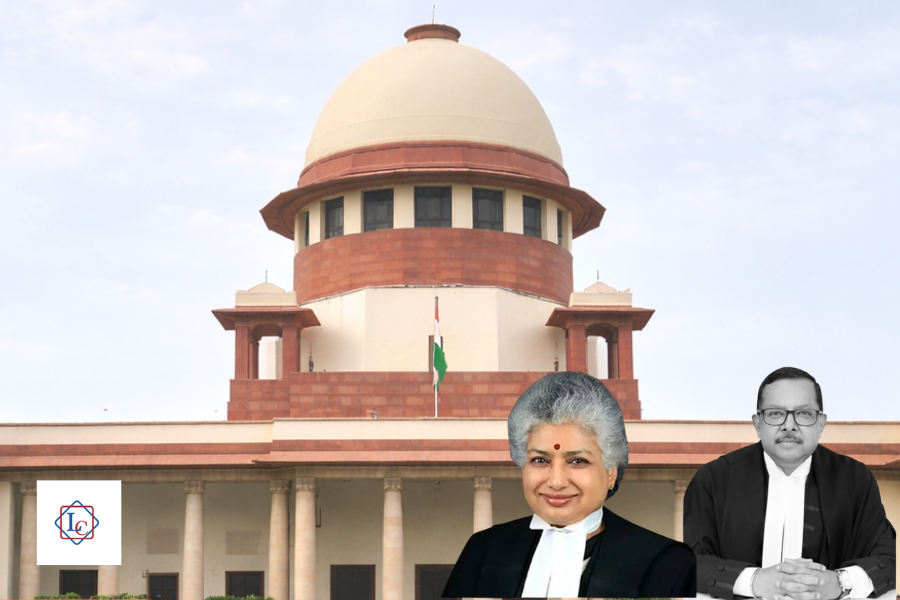
The Supreme Court held that a surety can only be held liable for the amount he originally agreed to guarantee. Where a bank permits the borrower to overdraw beyond the sanctioned limit without the surety’s consent, the surety stands discharged for the excess amount but remains liable for the original guaranteed sum under section 133 of the Indian Contract Act, 1872.
THE Supreme Court has held that a guarantor cannot be held liable for loan amounts withdrawn by the borrower beyond the sanctioned limit without the guarantor’s consent, though the guarantor remains liable for the loan amount originally guaranteed.
A Bench of Justices B.V. Nagarathna and Ujjal Bhuyan set aside the Gujarat High Court’s judgment which had ruled that sureties must either be liable for the entire amount or not at all.
The dispute arose in 1993 when M/s Darshak Trading Company obtained a cash-credit facility of Rs 4,00,000 from Bhagyalaxmi Co-operative Bank Ltd. Two individuals stood as guarantors for this specific amount. The borrower, allegedly in connivance with certain bank officials, withdrew amounts far exceeding the sanctioned limit.
Also read: Personality rights and John Doe orders: Why celebrities are rushing to courts
When default occurred, the bank filed a suit seeking recovery of Rs 26,95,196.75, nearly seven times the original sanctioned amount, from both the borrower and the guarantors.The Board of Nominees decreed the suit against the principal borrower but dismissed it against the sureties.
The Gujarat State Co-operative Tribunal reversed this in part, holding the sureties liable to the extent of Rs 4,00,000 with interest.
The Gujarat High Court, however, quashed this order, reasoning that since the bank had permitted overdrawals without the sureties’ consent, they stood discharged entirely under section 139 of the Indian Contract Act, 1872.
Senior Counsel Sri Raghavendra S. Srivatsa, appearing for the bank, argued that the High Court had erred in interpreting section 133 of the Act. He contended that while a surety is discharged as to transactions subsequent to a variance made without consent, they remain liable for dues outstanding up to the point of variation. He relied upon precedents including Bishwanath Agarwala v. State Bank of India where the Jharkhand High Court had upheld a similar bifurcation of liability.
Counsel for the sureties pressed into service section 139, arguing that the bank’s act of permitting overdrawals was inconsistent with the sureties’ rights and impaired their eventual remedy. They contended that the additional lending occurred without their knowledge and had they been informed, they would have been aware of whether they were liable for the additional dues. In absence of any intimation, the sureties argued they stood discharged of all liabilities.
The Court examined the provisions relating to guarantees under Chapter VIII of the Indian Contract Act, particularly sections 133 and 139.
Section 133 provides that any variance in the terms of the contract between the principal debtor and creditor, made without the surety’s consent, discharges the surety only with respect to transactions subsequent to the variance. Section 139, in contrast, applies when the creditor’s act or omission impairs the surety’s eventual remedy against the principal debtor.
The Bench held that the excess overdrawal functioned as a fundamental variation of the terms of the initial contract of guarantee, wherein the extent of liability to which the sureties had consented was exceeded.
However, the Court clarified that discharge under section 133 is not absolute in nature. Justice Nagarathna, authoring the judgment, observed that, “a plain reading of the said provision reveals that such discharge of the surety is not absolute in nature. The surety is discharged only in respect of transactions that occurred subsequent to the variance of the terms of the contract.”
The Court rejected the High Court’s “all or nothing” approach, holding that, “the observation of the High Court in the impugned order that the sureties must either be liable for the entire loan amount or not at all is erroneous.”
The bifurcation deemed impermissible by the High Court was, the Supreme Court held, in fact mandated by the statute to determine the extent of the sureties’ liability.
On the applicability of section 139, the Court laid down a two-fold test. For section 139 to apply, the creditor must either act inconsistently with the surety’s rights or omit to act in a manner duty-bound, and such act or omission must impair the surety’s eventual remedy against the principal debtor.
In the present case, while the bank’s conduct affected the sureties’ position regarding the excess amount, there was no impairment of their eventual remedy against the principal debtor. The Court also reiterated the settled principle that no bar can be placed on the creditor to restrict their ability to recover amounts from the sureties before proceeding against the principal debtor.
Allowing the appeal, the Court set aside the Gujarat High Court’s judgment and held the sureties liable to the extent of Rs 4,00,000 with applicable interest, being the original sanctioned amount for which they had consented to stand as guarantors. They were held not liable for the excess amounts permitted to be withdrawn from the cash-credit facility.
Case Title: Bhagyalaxmi Co-operative Bank Ltd. v. Babaldas Amtharam Patel (D) through LRs & Ors., 2026 SC.
Click here to read the judgment.


Leave a Reply