
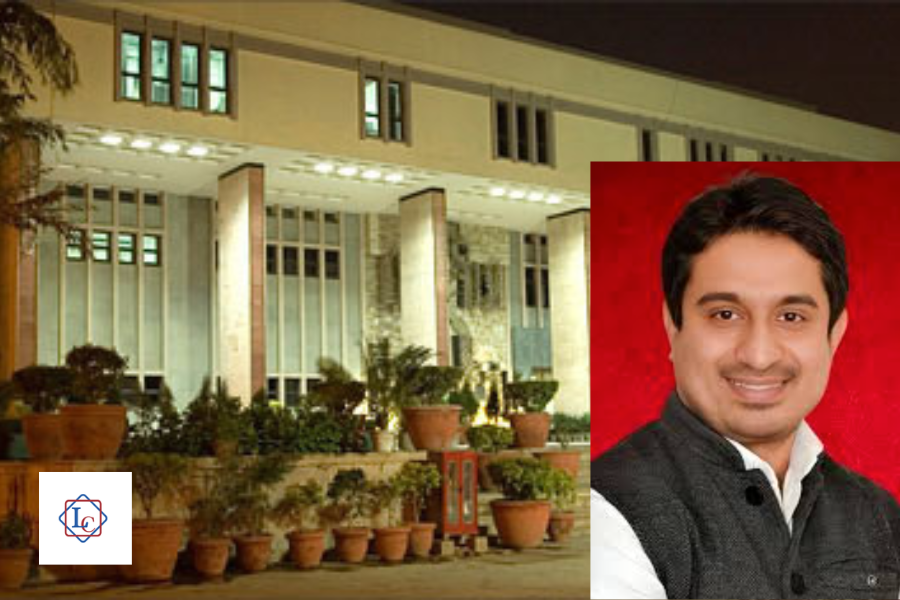
The Delhi High Court on 3rd March stayed a sessions court order that had put on hold the bail granted to Indian Youth Congress president Uday Bhanu Chib in connection with the shirtless protest at the India AI Impact Summit, holding that the impugned order reflected no application of mind.
THE Delhi High Court on Monday stayed a sessions court order that had halted the bail granted to Indian Youth Congress president Uday Bhanu Chib in connection with the shirtless protest at the India AI Impact Summit, observing that the impugned order reflected no application of mind.
Justice Saurabh Banerjee, while issuing notice to the Delhi Police, said he was prima facie not satisfied with the sessions court’s decision and emphasised that any order affecting personal liberty must disclose reasons.
Chib, who was arrested on 24th February in connection with the protest staged at Bharat Mandapam on 20th February, had been granted bail by a duty magistrate at around 3.30 am on 28th February after the expiry of his four-day police custody.
Judicial Magistrate First Class Vanshika Mehta had granted him bail on a personal bond of Rs 50,000 after observing that the Crime Branch had failed to provide sufficient reasons for seeking an extension of his custody. However, hours later the same evening, Additional Sessions Judge Amit Bansal stayed the bail order on a plea moved by the Delhi Police and listed the matter for hearing on 6th March.
Also read: The Kerala Story 2: Fresh PIL in high court seeks removal of ‘Kerala’ from film title
Senior Advocate Siddharth Luthra, appearing for Chib along with Senior Advocate Salman Khurshid and other counsel, argued before the High Court that the sessions court had stayed the magistrate’s bail order ex parte, without issuing notice to the accused or giving him an opportunity to be heard.
Luthra contended that the magistrate had three options available at the remand stage, namely to extend police custody, send the accused to judicial custody, or grant bail, and in the present case bail was granted after declining further police custody. He submitted that once a bail application is decided on merits, the order is not interlocutory and cannot be revised.
Terming the sessions court’s decision wholly bereft of reasoning, Luthra read out the order in court and argued that the Supreme Court judgment in Parvinder Khanna v. Enforcement Directorate cited by the police had been wrongly read and misinterpreted by the sessions court. He also raised serious concerns about procedural fairness, stating that the police had not supplied them with a copy of the revision petition before the stay was granted.
Opposing the plea, Additional Solicitor General DP Singh, along with Standing Counsel Sanjay Lao and Additional Public Prosecutor Raghavendra Verma, submitted that the investigation was ongoing and that what was stayed was essentially a remand order, with bail being only consequential.
The prosecution contended that no bail application had been filed on behalf of Chib and that the bail order was passed without an application and without granting time to argue. It was further argued that the sessions court has the power to stay a bail order if it is a faulty one.
Justice Banerjee, however, remained unconvinced by the prosecution’s submissions. On perusing the sessions court order, the judge questioned, that “Where is reasoning in this order? You see page 1… turn over the page… where is reasoning or finding?” The court underscored that when a court stays a bail order and affects liberty, it must show how the precedent relied upon applies to the facts of the case. The judge also observed that, “Some application of mind has to be there… If there is no application of mind, the order has to be stayed.”
Dictating the order in open court, Justice Banerjee noted that although the sessions court had detailed the State’s submissions and cited the Supreme Court ruling in Parvinder Singh, there was no clear reasoning or reflection of its applicability while granting the stay.
The sessions court had stayed the magistrate’s order till further orders while describing the case as rare and very exceptional, without elaborating on the circumstances warranting such a finding. The judge remarked that, “Let’s not go into all those. I am openly saying that I am not satisfied with your submissions. The order has to be stayed because there is no application of mind.”
The High Court accordingly stayed the sessions court order and issued notice to the Delhi Police, thereby reviving the magistrate’s order granting bail to Chib.
Also read: Supreme Court rules post-bail conduct irrelevant in appeal against grant of bail
Following the High Court’s intervention, the Patiala House Court on Tuesday issued a release order for Chib after the Delhi Police submitted a report verifying his bail surety.
Chib had been accused of being the main conspirator behind organising an unlawful assembly on 20th February at Bharat Mandapam during the India AI Impact Summit and Expo 2026, where slogans were raised against Prime Minister Narendra Modi and alleged attempts were made to incite a riot-like situation.
The police had also alleged that Chib, along with co-accused persons, obstructed and assaulted officials on duty and did not cooperate during interrogation. The case diary noted that Chib was not physically present at the protest site but was allegedly directing the protest and communicating with other accused persons.
Meanwhile, in a related development, a Delhi court on Sunday granted bail to nine other Indian Youth Congress members arrested in connection with the same protest, holding that their actions amounted to political dissent rather than recidivist violence or organised crime.
Judicial Magistrate First Class Ravi of the Patiala House Court ordered the release of Krishna Hari, Narshimha Yadav, Kundan Kumar Yadav, Ajay Kumar Singh, Jitendra Singh Yadav, Raja Gurjar, Ajay Kumar Vimal alias Bantu, Saurabh Singh and Arbaz Khan on a bond of Rs 25,000 each. The court observed that, “The protest, at highest, constituted symbolic political critique during a public event.”
The protest that led to their arrest occurred on the final day of the five-day India AI Impact Summit, which was promoted as a major gathering on artificial intelligence in the Global South and attended by world leaders, technology executives and exhibitors from 30 countries.
During the protest, IYC members entered the venue and removed their shirts to reveal T-shirts bearing images of Prime Minister Narendra Modi and US President Donald Trump, with slogans reading “PM is compromised” and criticisms of the India-US trade deal. The protest sparked a political row, with the BJP criticising the demonstration as an attempt to tarnish India’s global image while the Congress defended it as a peaceful expression of democratic dissent by the youth.


Leave a Reply