
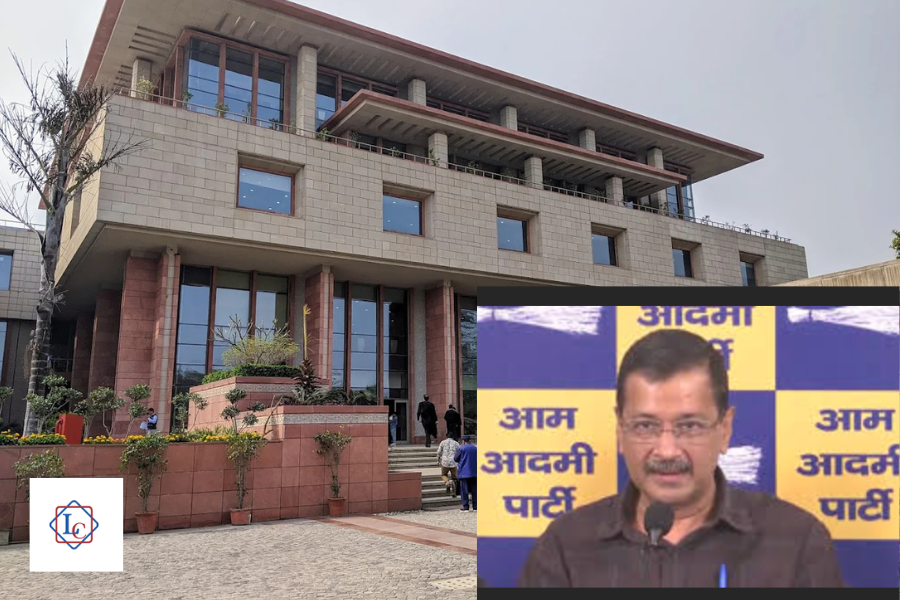
Arvind Kejriwal has approached the Supreme Court seeking transfer of the CBI’s revision petition in the Delhi excise policy case from Justice Swarana Kanta Sharma’s bench. The plea was filed after Delhi High Court Chief Justice D. K. Upadhyaya declined his administrative request, stating the case had been assigned as per roster.
FORMER Delhi Chief Minister and AAP national convenor Arvind Kejriwal on Sunday approached the Supreme Court of India seeking transfer of the CBI’s revision petition in the excise policy case from the bench of Justice Swarana Kanta Sharma of the Delhi High Court to another judge. The move comes after Delhi High Court Chief Justice Devendra Kumar Upadhyaya declined Kejriwal’s representation seeking the same relief on the administrative side.
Kejriwal, along with former Deputy Chief Minister Manish Sisodia, has also challenged the high court’s summons in the Apex Court. Sisodia has filed a separate petition questioning the summons issued against him in the same case, and the matter is likely to be listed for hearing on Monday.
The high court’s Registrar General had communicated the rejection on March 13 to eight persons who had sought the transfer, including Kejriwal. The communication conveyed the Chief Justice’s view that the CBI’s revision petition was assigned to Justice Sharma in accordance with the existing roster, and that any question of recusal was a matter for the judge concerned to decide.
Chief Justice Upadhyaya stated that, “I, however, do not find any reason to transfer the petition by passing an order on the administrative side.”
Kejriwal had made a representation to the Chief Justice on March 11, expressing apprehension that the proceedings before Justice Sharma may not receive a hearing marked by impartiality and neutrality. He had cited a “grave, bona fide, and reasonable apprehension” regarding the conduct of the proceedings as his ground for seeking transfer.
The controversy traces back to March 9, when Justice Sharma heard the CBI’s revision petition challenging the trial court’s February 27 order discharging all 23 accused in the case, including Kejriwal, Sisodia and former Telangana MLC K Kavitha.
While issuing notice, Justice Sharma observed that certain findings of the trial court regarding statements of witnesses and approvers at the charge stage were “prima facie erroneous and need consideration.”
She also stayed the trial court’s direction recommending departmental proceedings against the CBI’s investigating officer and requested the trial court hearing the connected Enforcement Directorate case under the Prevention of Money Laundering Act to defer proceedings.
Kejriwal contended that the March 9 order did not disclose any reasons explaining what “perversity” warranted ex parte intervention. He argued that interim interference with a discharge order is an extraordinary course to be exercised only in the rarest circumstances and upon clear grounds of illegality.
The direction to defer PMLA proceedings was particularly objectionable, he submitted, because the ED was not even a party before the court in the revision petition filed by the CBI.
Also read: Article 21 and the right to die: Tracing passive euthanasia law in India
His representation further noted that the same judge had earlier dealt with multiple matters arising from the excise policy investigation and had expressed detailed prima facie views on the same nucleus of facts and roles.
Justice Sharma had heard Kejriwal’s petition against his arrest, bail applications filed by Sisodia, Sanjay Singh and Kavitha, and had, according to Kejriwal, never granted relief to any of the accused. Three of those judgments were subsequently set aside by the Supreme Court, and one was referred to a larger bench, which Kejriwal argued demonstrated that the earlier approach had been “found legally vulnerable.”
Kejriwal also pointed out that in a revision petition of this magnitude, involving voluminous records and multiple chargesheets, at least four to five weeks is ordinarily granted to parties to file responses. The grant of only one week, he contended, conveyed an apprehension of predisposition rather than the measured consideration such proceedings demand.
The Chief Justice, however, remained unpersuaded. His communication made clear that the roster-based assignment of the case did not warrant administrative intervention, and that the question of whether a judge should recuse herself from a matter was a decision that belonged to the judge alone.
Kejriwal had clarified in his representation that his request was, “not directed at any personal predilection, but at the objective test of reasonable apprehension in the mind of a fair-minded and informed litigant seeking justice.” He described the concern as institutional, invoking the principle that justice must not only be done but must also be seen to be done.
The underlying case relates to the Delhi government’s excise policy of 2021-22, which sought to privatise liquor trade in the national capital. The CBI and the ED had alleged that the policy was used to grant undue advantage to private entities in exchange for kickbacks. A trial court on February 27 discharged all 23 accused, holding that the CBI had failed to make out a prima facie case. Special Judge Jitendra Singh had pulled up the agency in strong terms, observing that the voluminous chargesheet had many lacunae unsupported by any witness or statement. Kejriwal, the court noted, had been implicated without any cogent material.
The CBI promptly challenged the discharge order before the Delhi High Court by way of a revision petition. When Justice Sharma took up the matter on March 9, the developments that followed prompted Kejriwal and seven other accused to write to the Chief Justice seeking reassignment. With that route now exhausted, the matter has moved to the Supreme Court.
The CBI’s revision petition remains listed before Justice Sharma on Monday.
Case title: CBI v. Kuldeep Singh & Ors., Crl. Rev. Petition No. 134 of 2026


Leave a Reply