
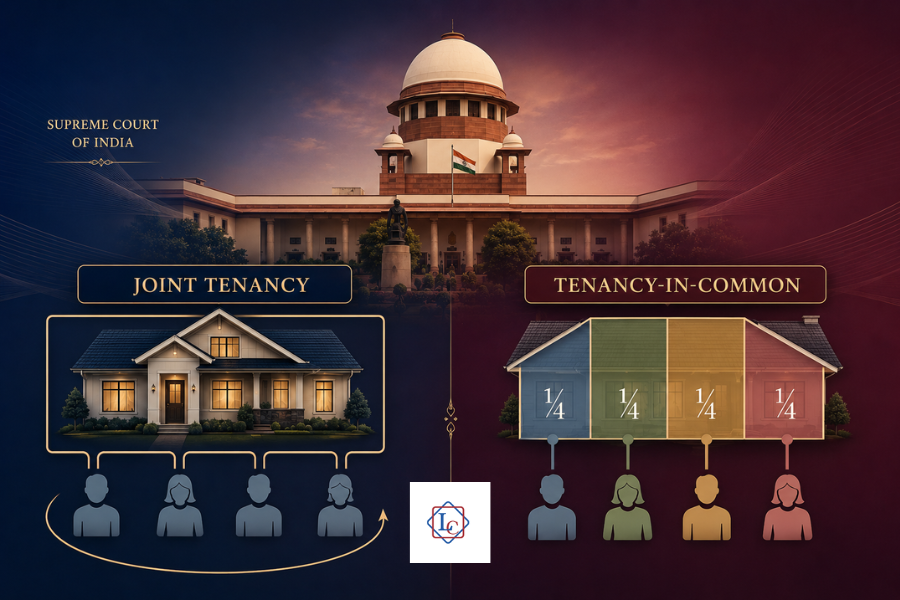
In a recent judgment, the Supreme Court has reiterated that the heirs of a Hindu male dying intestate succeed under sections 8 and 19 of the Hindu Succession Act, and so they take as tenants-in-common, with their shares fixed at one-fifth each by section 10. Since each heir holds a definite, identifiable share, no question of karta-ship arises.
Recently the Supreme Court in Darubai v. Kamalabai held that the heirs of a Hindu male dying intestate taking his property as tenants-in-common, meaning each of them holding a definite and separate share of their own, and not as joint tenants, who would hold the whole property together without any individual having a distinct share.
Because each heir owns an identifiable share, no single co-heir can act as karta to sell the shares of the others on the ground of legal necessity.
This raises a question that everyone from a legal background ought to be able to answer with precision: what is the difference between joint tenancy and tenancy-in-common.
This explainer sets out the distinction from its origins in English property law, through the Mitakshara coparcenary, to the statutory scheme of the Hindu Succession Act, 1956 that governs the question today.
The distinction decides what happens to a co-owner’s interest when that co-owner dies, settling whether the surviving owners absorb the share or whether it instead passes down to the deceased’s own heirs.
The Court raised and resolved this issue in Darubai v. Kamalabai, where a step-mother claimed the authority of a karta to sell part of a property that her late husband had left jointly to her and his four daughters.
The Court held that because each of the five heirs took a fixed one-fifth share, there was no joint estate over which any karta-ship could be exercised, and the sale beyond her own share therefore could not stand.
To see why that conclusion follows almost inevitably from the nature of the two holdings, it helps to begin with what each of them actually is.
Also read: Passive euthanasia: Article 21 and the right to die with dignity
What is the difference between joint tenancy and tenancy-in-common?
In a joint tenancy the co-owners together hold the whole property as a single, unified ownership, and none of them holds a distinct or ascertained share of their own. In a tenancy-in-common, by contrast, each co-owner holds a separate and definite share, even though the property has not been physically divided and possession of it remains common to all.
The difference is not about who occupies which part of the land, because in both forms every co-owner is entitled to possess the whole. It is about whether the law treats each owner as having an identifiable share that is theirs to deal with, to sell, and to pass on.
That single difference, the presence or absence of a distinct share, is what produces every other consequence that follows. Once you know whether a co-owner has a share of their own or merely a part in a collective whole, the rules on sale, on succession, and on what happens at death all fall into place.
What are the four unities in a joint tenancy?
A joint tenancy can come into existence at common law only when the four unities are all present, namely the unities of possession, interest, title and time, often remembered by the mnemonic PITT. The requirement is strict because the law treats the joint tenants as a single owner, and a single owner can only exist where the four strands of ownership are perfectly aligned.
Unity of possession means each co-owner is entitled to possess the whole of the property and not merely a portion of it. Unity of interest means each holds an interest identical to the others in its nature, its extent and its duration, so that no one of them has a larger or longer interest than the rest.
Unity of title means all the co-owners derive their interest from one and the same instrument, such as a single deed or grant. Unity of time means that the interest of each of them vests at one and the same moment, as the standard accounts of English co-ownership explain.
Also read: Grant of bail must rest on merits, not on monetary deposits, Supreme Court reiterates
A tenancy-in-common requires only the first of these, unity of possession, and dispenses with the other three entirely. This is why tenants-in-common may hold unequal shares, acquired at different times and under different documents, while still sharing the right to possess the whole.
The absence of the four unities is therefore not a flaw in a tenancy-in-common but its very nature. It marks the holding out as one of separate, individually owned shares rather than a single ownership held by several people at once.
What is the right of survivorship?
The right of survivorship, known in the older authorities by its Latin name jus accrescendi, is the rule that on the death of a joint tenant nothing passes to that person’s heirs at all. Instead the interest of the surviving joint tenants enlarges to absorb the share of the one who has died, and this continues with each successive death until the last survivor holds the entire property alone.
The reason is that a joint tenant is regarded as owning no separate share while the joint tenancy lasts. Having no share of their own, the deceased has nothing capable of being left by will or of passing on intestacy, a consequence explained at length in the English land-law commentary.
A tenancy-in-common carries no survivorship whatsoever. On the death of a co-owner, that owner’s defined share devolves upon their own legal heirs under the applicable law of succession, and the shares of the other co-owners are left wholly untouched.
This is the exact mechanism the Supreme Court applied in Darubai. The Court reasoned that under a tenancy-in-common a share is inherited on death by the holder’s personal heirs, whereas under a joint tenancy the property simply remains with the survivors, so that the choice between the two forms determines the very nature of what a person inherits.
Can a joint tenancy be converted into a tenancy-in-common?
Under English law a joint tenancy can be turned into a tenancy-in-common through what is called severance. This may be brought about by one tenant alienating their interest, by mutual agreement among the co-owners, or by a course of conduct inconsistent with the continuance of the joint tenancy.
Once a joint tenancy has been severed, the right of survivorship ceases to operate from that point onward, and the former joint tenant holds a distinct share that will now pass to their own heirs. The significance of severance is that it converts a collective ownership into a holding of separate shares without the property itself being physically divided.
This machinery belongs to the common-law system of co-ownership and has no direct counterpart in the Hindu law of intestate succession. As explained below, the Hindu statute does not leave the form of holding to be altered by the parties, because it fixes that form by operation of law from the very moment the property devolves.
Does Hindu law recognise joint tenancy?
Hindu law has long refused to recognise joint tenancy in the English sense, save in one solitary instance. The position was settled as early as 1896, when the Judicial Committee of the Privy Council in Jogeswar Narain Deo v. Ram Chund Dutt held that the principle of joint tenancy is unknown to Hindu law except in the case of the coparcenary of an undivided Hindu family.
That single exception is itself instructive. The Mitakshara coparcenary is the one genuinely survivorship-based holding known to Hindu law, for there the coparceners take an interest that expands and contracts with the births and deaths in the family, and that no individual coparcener can point to as a fixed share while the coparcenary subsists.
Under the unamended law, on the death of a coparcener his interest devolved by survivorship upon the surviving coparceners and not upon his separate heirs. The coparcenary, in other words, behaved very much like a joint tenancy, while ordinary inheritance did not.
It is for this reason that survivorship in Hindu law has always been the mark of the coparcenary and not of ordinary intestate succession. The distinction between these two situations, the surviving coparcenary on one hand and the devolution of separate property on the other, is exactly what the statutory scheme of 1956 was designed to clarify.
How do heirs inherit property under section 8 of the Hindu Succession Act?
Section 8 of the Hindu Succession Act, 1956 lays down the general rules of succession for the property of a male Hindu who dies intestate. It directs that his property devolve first upon the Class I heirs set out in the Schedule, a class that includes the widow, the sons and the daughters, each of whom takes a share under the distribution rules contained in section 10.
The form in which those heirs hold what they take is then settled by Section 19. That provision states that where two or more heirs succeed together to the property of an intestate, they take it per capita and not per stirpes, and as tenants-in-common and not as joint tenants.
The combined effect of these provisions is that the heirs of an intestate take definite and separate shares from the moment of devolution. Each share is individually owned, capable of being dealt with and of being passed on, and none of the heirs holds a fluctuating interest in a collective whole.
This is why, when Dajiba died, his widow and four daughters did not become a joint family holding the property collectively, but five tenants-in-common each owning a fixed one-fifth share. The statute itself made the holding a tenancy-in-common, and left no room for any of them to claim a survivorship-based or coparcenary interest in the property.
Why does property inherited under Section 8 not become joint family property?
The point that property inherited under Section 8 does not take on the character of coparcenary or joint family property was settled by the Supreme Court in Commissioner of Wealth Tax v. Chander Sen, (1986) 3 SCC 567. The Court there held that when a son inherits his father’s property under Section 8, he takes it as his own individual property and not as the karta of a Hindu Undivided Family, so that his own son acquires no right in it by birth.
The reasoning rests on the non obstante clause in section 4 of the Act, which provides that the statutory scheme overrides any pre-existing rule of Hindu law on a matter for which the Act makes provision. Once section 8 governs the devolution, the old Mitakshara notion that inherited ancestral property automatically founds a coparcenary in the inheritor’s hands simply ceases to apply.
This was reaffirmed in Yudhishter v. Ashok Kumar, (1987) 1 SCC 204, where the Court held that property inherited under section 8 does not assume the character of coparcenary property and that the descendants of the heir acquire no right in it by birth, because the inheritance is individual and statutory in nature. The same understanding was carried forward in M. Arumugam v. Ammaniammal, (2020) 11 SCC 103, which read section 30 alongside Section 19 to confirm that heirs hold as tenants-in-common until the property is divided or otherwise dealt with.
The most comprehensive statement of the position came in Uttam v. Saubhag Singh, (2016) 4 SCC 68. On a conjoint reading of sections 4, 8 and 19, the Court held that once joint family property is distributed under section 8 on the principles of intestacy, it ceases to be joint family property in the hands of those who succeed to it, and they hold it as tenants-in-common and not as joint tenants.
Why could the step-mother not sell the property as karta in Darubai v. Kamalabai?
The answer follows directly from everything above. Because the widow and the four daughters took as tenants-in-common, each holding a distinct and identifiable one-fifth share, there was no undivided joint family estate of the kind a karta exists to manage.
The office of karta presupposes a coparcenary or joint family in which the members have no separate shares and the manager acts for the collective whole. Whereas, here, every co-owner already has a fixed share that is their’s alone, the very premise on which a karta’s power to alienate for legal necessity rests is missing.
The Court therefore held that the step-mother could deal only with the one-fifth share that had vested in her, and that her purported sale of a larger portion of the property, justified as an act of karta-ship undertaken out of legal necessity, was invalid. Each of the other co-owners’ shares lay beyond her reach, because she was a co-sharer among equals and not the head of a joint family.
Related case title: Darubai & Anr. v. Kamalabai & Ors., 2026 INSC 613.


Leave a Reply