
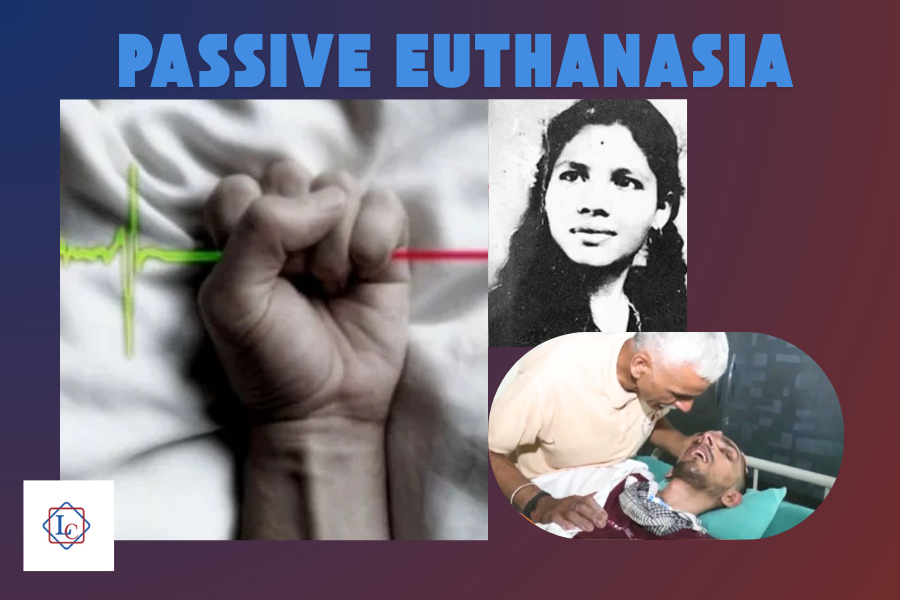
The Supreme Court’s decision to permit withdrawal of life support for Harish Rana marks the first practical application of India’s passive euthanasia framework. This piece traces the evolution of the right to die with dignity from P. Rathiram (1994) and Gian Kaur (1996) through Aruna Shanbaug (2011), Common Cause (2018), and the 2023 modifications.
Table of Contents
ARTICLE 21 of the Constitution states that no person shall be deprived of life or personal liberty except according to procedure established by law. But what does “life” mean? The Supreme Court has spent decades answering that question.
In Maneka Gandhi v. Union of India (1978), the Court held that life is not mere animal existence. Life, the Court said, means living with human dignity. This interpretation was expanded in Francis Coralie Mullin v. Administrator, Union Territory of Delhi (1981), where it was held that the right to life includes the right to adequate nutrition, clothing, shelter, and the right to carry on functions that constitute the meaningful expression of the human self.
If the right to life means the right to live with dignity, a question follows. Does it also mean the right to die with dignity? On March 11, 2026, a Bench of Justice J.B. Pardiwala and Justice K.V. Viswanathan permitted the withdrawal of life-sustaining treatment for 32-year-old Harish Rana, who had been in a permanent vegetative state for 13 years. It was the first time India’s passive euthanasia framework was applied in an individual case.
P. Rathinam v. Union of India (1994)
The question whether the right to life includes the right to die first came before the Supreme Court in this case. A two-judge bench was asked to examine the constitutional validity of section 309 of the Indian Penal Code, which criminalises attempt to suicide.
The Court struck down section 309 as unconstitutional. It held that the right to life under Article 21 includes the right not to live a forced life. A person cannot be compelled to enjoy the right to life to their detriment, disadvantage, or disliking, the Court reasoned. The right to live, therefore, includes the right not to live.
The judgment drew from the principle that fundamental rights have both positive and negative aspects. If a person has the right to live, they must also have the right to end that life. The Court also noted that punishing a person who has attempted suicide and failed adds cruelty to cruelty. The person is already in distress. Prosecuting them serves no purpose.
P. Rathinam recognised the right to die as part of Article 21. But this position did not stand for long.
Gian Kaur v. State of Punjab (1996)
Two years later, a Constitution Bench reconsidered the issue. The question before the Court was the validity of section 306 IPC, which deals with abetment of suicide. But the Court also examined P. Rathinam and its holding on section 309.
The Constitution Bench overruled P. Rathinam. It held that the right to life under Article 21 does not include the right to die. The right to life is inherently positive, the Court reasoned. It is a natural right. The right to die is the antithesis of the right to life. It is not a right at all. Extinguishing life cannot be read into a provision that protects life.
The validity of both section 306 and section 309 IPC was upheld.
But the Court made an observation that would shape future jurisprudence. It noted that the right to live with human dignity would mean the existence of such a right up to the end of natural life. This, the Court added, may include the right of a dying man to die with dignity when his life is ebbing out. The Court distinguished between the right to die, which it rejected, and the right to die with dignity at the end of natural life, which it left open.
This distinction became the foundation for India’s passive euthanasia framework. The right to die was not recognised. But the right to a dignified death, when life is ebbing out naturally, was not foreclosed.
Executive action: Law Commission reports and legislative attempts
In 2006, the 196th Law Commission of India examined medical treatment to terminally ill patients. It observed that withholding life support or medical treatment of terminally ill patients does not attract criminal liability, provided it is done in the best interest of the patient. The Commission recommended that a law be enacted to protect medical practitioners who withdraw treatment in such cases.
In 2012, the 241st Law Commission Report, titled “Passive Euthanasia: A Relook“, recommended a formal legislative framework. The Commission proposed that passive euthanasia be permitted for patients in a persistent vegetative state or suffering from terminal illness, subject to safeguards. It suggested the creation of medical boards to certify that the patient’s condition is irreversible.
In 2016, the Medical Treatment of Terminally Ill Patients (Protection of Patients and Medical Practitioners) Bill was drafted. It sought to provide legal protection to patients who refuse medical treatment and to medical practitioners who withdraw such treatment. The Bill was not passed by Parliament. It lapsed.
Aruna Ramchandra Shanbaug v. Union of India (2011)
Aruna Shanbaug was a nurse at King Edward Memorial Hospital in Mumbai. On November 27, 1973, she was sexually assaulted by a ward attendant. She was strangled with a chain, and the deprivation of oxygen left her with severe brain damage. She fell into a persistent vegetative state. She remained in that state for more than four decades.
In 2009, journalist Pinki Virani approached the Supreme Court as Shanbaug’s “next friend”, seeking permission for euthanasia. The petition argued that Shanbaug’s continued existence was a violation of her right to live in dignity.
The Court refused to grant euthanasia in Shanbaug’s case. The hospital staff who had been caring for her opposed withdrawing life support, and the Court gave weight to their position. But while the petition was rejected, passive euthanasia was recognised in India for the first time.
Since no law existed on the subject, the Court laid down interim guidelines. A request for withdrawal of treatment could be made by family members, doctors, or a next friend acting in the patient’s best interest. High court approval was required. A two-judge bench would decide the case after consulting a committee of three doctors. The Court held that passive euthanasia could be made lawful only by legislation, and until Parliament acted, the Court’s guidelines would govern the field.
Aruna Shanbaug died on May 18, 2015, after being in a coma for 42 years.
Common Cause v. Union of India (2018)
A Constitution Bench, comprising Chief Justice Dipak Misra, Justice A.K. Sikri, Justice A.M. Khanwilkar, Justice D.Y. Chandrachud, and Justice Ashok Bhushan, heard a petition filed by a registered NGO seeking recognition of living wills and passive euthanasia.
The Court ruled that the right to die with dignity is a fundamental right under Article 21. It held that, “though the sanctity of life has to be kept on the high pedestal yet in cases of terminally ill persons or PVS patients where there is no hope for revival, priority shall be given to the Advance Directive and the right of self-determination.”
Also read: Doctrine of basic structure
What is ‘living will’?
The judgment introduced the concept of advance medical directives, commonly known as living wills. A living will is a written document that allows a person to give explicit instructions in advance about the medical treatment to be administered when they are terminally ill or no longer able to express informed consent. The 2018 judgment laid down a detailed procedure governing living wills.
On who can execute a living will, the Court held that any adult who is of sound mind and in a position to communicate can execute an advance directive. The person must understand the consequences of executing such a directive. The directive must be voluntary, made without coercion or inducement.
On the contents of a living will, the Court specified that the document must clearly indicate the circumstances in which medical treatment may be withdrawn. It must specify the nature of illness or condition that would trigger the directive. It must name a guardian or close relative who would be authorised to give consent for withdrawal of treatment if the executor becomes incapable of taking decisions.
On how a living will is to be recorded and preserved, the Court held that the directive must be signed by the executor in the presence of two attesting witnesses. It must then be countersigned by a Judicial Magistrate of First Class. The Magistrate must be satisfied that the document has been executed voluntarily and without coercion. A copy of the directive was to be kept by the Magistrate, another copy by the designated guardian, and a third copy by the local government authority or the registry of the District Court.
On when and by whom a living will can be enforced, the Court held that when a patient’s condition reaches the stage where the directive becomes operative, the treating physician must first ascertain the genuineness of the directive.
A medical board must then be constituted. Under the 2018 guidelines, this board was to consist of the head of the treating hospital and three other experts with at least 20 years of experience.
If the board certifies that the patient’s condition is irreversible, the directive can be acted upon. But the board’s decision had to be forwarded to the district collector, who would constitute another medical board of three experts including the Chief District Medical Officer.
Only after this second board also certified the irreversibility of the condition could treatment be withdrawn. And even after both boards concurred, the decision had to be placed before the Judicial Magistrate of First Class for approval.
On appeal mechanisms, the Court held that if a hospital refuses to act on a living will, the executor or their family can approach the high court under Article 226 of the Constitution.
On revocation, the Court held that the executor can revoke or alter the advance directive at any time while they are competent to do so. The directive would be inapplicable if circumstances have changed since it was executed, or if there are reasonable grounds to believe that the executor would have changed their decision had they known of the changed circumstances.
The 2018 guidelines were detailed. But they were also cumbersome. The requirement of judicial magistrate’s countersignature at the execution stage, the involvement of the district collector, the two-tier medical board system, and the final approval by the magistrate before withdrawal made the process difficult to navigate.
2023 Modifications
In 2019, the Indian Council of Critical Care Medicine moved an application before the Supreme Court highlighting difficulties faced by families and hospitals in executing living wills.
In January 2023, a Constitution Bench comprising Justice K.M. Joseph, Justice Ajay Rastogi, Justice Aniruddha Bose, Justice Hrishikesh Roy, and Justice C.T. Ravikumar modified the 2018 guidelines.
The requirement for a judicial magistrate’s countersignature on a living will was removed. Attestation by a notary or gazetted officer was held to be sufficient.
The restriction on naming only one guardian was relaxed. More than one guardian or close relative could now be designated as a surrogate decision-maker.
The role of the district collector was removed. The two-tier medical board system was retained but simplified. A primary medical board would be constituted by the treating hospital. If this board certifies that the patient’s condition is irreversible, a secondary medical board would be constituted. Both boards were expected to give their opinions within 48 hours.
The requirement of judicial magistrate’s approval before withdrawal was modified. Hospitals no longer needed to seek approval from a magistrate. They only needed to convey the medical board’s opinion to the magistrate.
The 2023 modifications also allowed for living wills to be stored in digital health records.
Also read: UGC equity regulations 2026 controversy: explained
Harish Rana v. Union of India (2026)
Harish Rana was 20 years old when he fell from the fourth floor of his paying guest accommodation in Chandigarh on 20 August 2013. He sustained severe traumatic brain injury and was left with 100 per cent quadriplegia. He fell into a permanent vegetative state. For 13 years, he remained in that state, sustained through Clinically Administered Nutrition and Hydration (CANH) delivered through a PEG tube. His condition showed no improvement.
In 2024, his father approached the Delhi High Court seeking permission for passive euthanasia. The High Court rejected the plea, holding that Harish was not terminally ill and was not being kept alive mechanically. It held that removing his feeding tubes would amount to active euthanasia.
The family approached the Supreme Court. The Court initially declined to allow passive euthanasia in August 2024 but directed the Uttar Pradesh government to cover medical expenses. In 2025, a fresh application was filed stating that Harish’s condition had worsened.
The Court constituted primary and secondary medical boards as required under the Common Cause guidelines. Both boards concluded that his condition was irreversible with negligible chances of recovery.
On March 11, 2026, the bench of Justice J.B. Pardiwala and Justice K.V. Viswanathan permitted withdrawal of life-sustaining treatment. The Court held that prolonging Harish’s biological life, when there was no improvement in his condition, was not in his best interest. The question, the Court stated, is not whether death is in the patient’s best interest, but whether continuing life-sustaining treatment is in the patient’s best interest.
The Court clarified that CANH administered via a PEG tube constitutes medical treatment, not basic care. Artificial nutrition and hydration, the Court held, is a form of medical treatment that can be withdrawn when it serves no therapeutic purpose. This addressed the Delhi High Court’s reasoning that removing feeding tubes would amount to active euthanasia.
Justice Pardiwala observed that, “for the past thirteen years, the appellant has lived a life defined by pain and suffering. A suffering made more cruel, as unlike most of us, he was stripped of his ability to even give voice to his anguish.”
The Court waived the mandatory 30-day reconsideration period, as all stakeholders were unanimous that treatment should be withdrawn. AIIMS was directed to admit Harish to its palliative care department.
The Court directed High Courts to instruct Judicial Magistrates to receive intimations from hospitals whenever medical boards arrive at a unanimous decision to withdraw life support. The Union government was directed to ensure that Chief Medical Officers maintain panels of registered medical practitioners for secondary boards.
The Court urged Parliament to enact legislation on passive euthanasia. Justice Pardiwala observed that the guidelines issued under Article 142 are only a “temporary constitutional bridge”. Despite the 196th and 241st Law Commission reports and the 2016 draft Bill, Parliament has not legislated on the subject.
What is active euthanasia?
Active euthanasia remains illegal in India. It involves deliberately administering lethal substances to cause death and may amount to culpable homicide under the Bharatiya Nyaya Sanhita. Passive euthanasia involves withdrawing or withholding treatment and allowing nature to take its course. Active euthanasia involves a direct act to end life. India has permitted only passive euthanasia.
Active euthanasia or physician-assisted dying is legal in the Netherlands, Belgium, Luxembourg, Canada, Colombia, Ecuador, Spain, New Zealand, and all six states of Australia. Several US states permit physician-assisted suicide for terminally ill patients. The United Kingdom’s House of Commons voted in favour of an assisted dying bill in June 2025.
Passive euthanasia and withdrawal of treatment: What is the difference?
There is confusion around what passive euthanasia means and how it differs from the routine withdrawal of treatment that happens in hospitals.
When a patient is brain dead, doctors may remove the ventilator. This is standard medical practice. The patient has no brain function. Death has effectively occurred. The ventilator is only keeping the organs functioning. When it is removed, the patient is declared dead. This happens in hospitals regularly. No court permission is required. No medical boards need to be constituted. It is a clinical decision taken by doctors in consultation with the family.
Passive euthanasia is different. It applies when the patient is not brain dead but is in a persistent vegetative state or is terminally ill with no hope of recovery. The patient is alive in the biological sense. The heart is beating. Breathing may be happening, with or without mechanical support. But there is no meaningful consciousness, no awareness, no interaction, no possibility of improvement. The body is alive. The person, in any meaningful sense, is not.
In such cases, the family may want to withdraw treatment so that nature can take its course. But because the patient is technically alive, withdrawing treatment raises legal questions. If treatment is withdrawn and the patient dies, is it causing death? Is it culpable homicide? Who can authorise such a decision? What safeguards exist to prevent misuse, to ensure that families are not withdrawing treatment for inheritance or financial reasons?
This is where the Supreme Court’s framework comes in. The Common Cause guidelines, the living wills, the primary and secondary medical boards, the intimation to magistrates, all of these are meant to govern situations where the patient is not brain dead but is in an irreversible condition. The framework provides legal protection to families and doctors who take the decision to withdraw treatment.
The Harish Rana case illustrates this confusion. Harish Rana was not on a ventilator. He was breathing on his own, with the help of a tracheostomy tube. He was being fed through a surgically inserted PEG tube. The Delhi High Court rejected his family’s plea because he was not on “mechanical life support” in the conventional sense. The High Court reasoned that removing his feeding tube would cause him to starve to death. This, the High Court held, would be active euthanasia, not passive euthanasia. Active euthanasia is illegal.
The Supreme Court disagreed. It held that Clinically Administered Nutrition and Hydration through a PEG tube is medical treatment. It is not basic care like giving food to a hungry person. It is a medical intervention that sustains biological existence. And medical treatment can be withdrawn when it serves no therapeutic purpose. Withdrawing such treatment is passive euthanasia, not active euthanasia.
The distinction, then, is this. If a patient is brain dead and doctors withdraw the ventilator, it is standard medical practice. If a patient is in a persistent vegetative state or is terminally ill, and treatment is withdrawn following the legal safeguards laid down by the Supreme Court, it is passive euthanasia. If someone administers a lethal injection to end life, it is active euthanasia, and it remains illegal in India.


Leave a Reply