
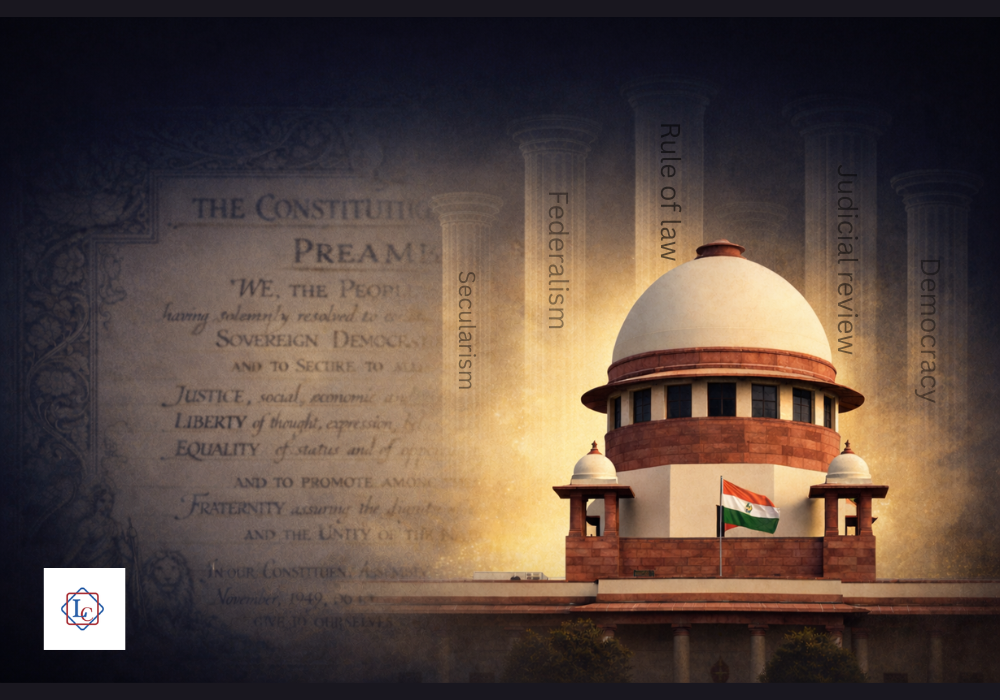
The doctrine of basic structure holds that while Parliament may amend any provision of the Constitution under Article 368, certain foundational features cannot be altered even by constitutional amendment. First articulated by the Supreme Court in Kesavananda Bharati v. State of Kerala (1973), the doctrine ensures that the Constitution can grow and adapt, but the spirit of the Constitution cannot be affected. This explainer traces the origin of the doctrine, its evolution through landmark cases, and its current legal position.
Table of Contents
- Origin of the doctrine of basic structure
- Shankari Prasad v. Union of India (1951)
- Sajjan Singh v. State of Rajasthan (1965)
- Golaknath v. State of Punjab (1967)
- The 24th, 25th, and 29th Constitutional Amendments
- Kesavananda Bharati v. State of Kerala (1973)
- Indira Nehru Gandhi v. Raj Narain (1975)
- The 42nd Amendment and Minerva Mills v. Union of India (1980)
- Waman Rao v. Union of India (1981)
- S.R. Bommai v. Union of India (1994)
- I.R. Coelho v. State of Tamil Nadu (2007)
Every constitution rests on certain foundational principles. These principles are not always written in any single provision; they permeate the entire document, giving it character and identity. The Constitution of India is no different. Strip away the detailed provisions on Parliament, the judiciary, fundamental rights, and what remains is a set of core commitments: that India shall be a democracy, that it shall be secular, that power shall be divided and checked, that citizens shall have enforceable rights. These commitments form the soul of the Constitution.
The doctrine of basic structure protects this soul. It holds that while Parliament has wide powers to amend the Constitution under Article 368, there are certain features so fundamental to the constitutional scheme that they cannot be touched, even by amendment. Parliament may add provisions, delete provisions, substitute provisions, but it cannot alter the basic structure. If an amendment attempts to do so, the Supreme Court will strike it down as unconstitutional.
The phrase “basic structure” appears nowhere in the constitutional text. You will not find it in Article 368, which deals with amendments, nor in any other provision. It is entirely a judicial creation, developed by the Supreme Court over two decades of constitutional adjudication, reaching its fullest expression in the landmark judgment of Kesavananda Bharati v. State of Kerala delivered on 24 April 1973.
Why does this matter? Consider what would happen without such a doctrine. A political party with a two-thirds majority in both Houses of Parliament could, in theory, abolish elections, eliminate fundamental rights, remove judicial review, and transform India into an authoritarian state. All of this could be done through constitutional amendments, that too by following proper procedure, and with presidential assent. The Constitution, instead of being a restraint on power, would become a tool for its concentration. The basic structure doctrine prevents this. It ensures that the Constitution can grow, adapt, and keep on breathing, but it cannot be made to destroy itself.
Origin of the doctrine of basic structure
The intellectual seeds of this doctrine were sown not in India but in Germany. In 1965, a German constitutional theorist named Dietrich Conrad delivered a lecture at Banaras Hindu University. He posed a question that appears simple but carries profound implications: can a parliament, using its power to amend a constitution, destroy the very constitution that gives it that power?
Conrad drew a distinction between two types of power. The first is the power to make a constitution (what French jurists call pouvoir constituant), which belongs to the people and is exercised at the founding moment. The second is the power to amend a constitution (pouvoir constitué), which is a delegated power, derived from and limited by the constitution itself. An amending body, Conrad argued, is a creature of the constitution. It cannot use its delegated power to destroy its creator. A child cannot unmake its parent.
As the ConstitutionNet analysis of the basic structure doctrine records, Conrad observed that “any amending body organised within the statutory scheme, howsoever verbally unlimited its power, cannot by its very structure change the fundamental pillars supporting its constitutional authority.” This observation, made in an academic lecture to a room of students and scholars, would later be quoted with approval by Justice H.R. Khanna in Kesavananda Bharati and become part of Indian constitutional law.
But ideas, however elegant, do not become law by themselves. They require judicial recognition. They need judges willing to adopt them, cases that present the right questions, and a moment in history when the idea meets its opportunity. In India, that recognition came through a series of cases decided between 1951 and 1973, each pushing the question of Parliament’s amending power closer to resolution.
Shankari Prasad v. Union of India (1951)
The question of Parliament’s amending power arose within months of the Constitution coming into force. Independent India had inherited a deeply unequal land ownership structure: zamindars and landlords holding vast estates while millions of cultivators worked as tenants with no security. The new government was committed to agrarian reform. Land reform laws, however, faced a constitutional obstacle: courts were striking them down for violating the fundamental right to property, then guaranteed under Articles 19(1)(f) and 31 of the Constitution. In 1950, just months after the Constitution came into force, the Patna High Court struck down the Bihar State Management of Estates and Tenures Act, 1949, as unconstitutional, citing a violation of zamindars’ right to equality due to lack of “just” compensation. Thestudyias
The following year, the Patna High Court declared the Bihar Land Reforms Act of 1950 unconstitutional under Article 14 of the Constitution, upon finding that its sliding scale of compensation, due to which large zamindars were getting paid as little as three times their net income while smaller landholders received twenty times theirs, and thus, violated the right to equality.
Similar challenges were mounted against the Uttar Pradesh Zamindari Abolition and Land Reforms Act, 1950, and the Madhya Pradesh Abolition of Proprietary Rights (Estates, Mahals, Alienated Lands) Act, 1950.
The Maharajadhiraja of Darbhanga, Sir Kameshwar Singh, whose estate covered some 2,800 square miles, stood to receive compensation of approximately nine lakh rupees for property that included lands purchased for a crore of rupees and mortgages worth half a crore.
Then, the Parliament responded with the Constitution (First Amendment) Act, 1951. This amendment inserted Article 31A (saving laws providing for acquisition of estates from challenge on grounds of violation of fundamental rights), Article 31B (validating certain acts and regulations listed in a new Ninth Schedule), and the Ninth Schedule itself. The mechanism was simple: place land reform laws in the Ninth Schedule, and they become immune from challenge on grounds of fundamental rights violation. A constitutional safe house, if you will.
Property owners challenged this amendment. Their argument rested on Article 13(2), which provides: “The State shall not make any law which takes away or abridges the rights conferred by this Part and any law made in contravention of this clause shall, to the extent of the contravention, be void.” A constitutional amendment, they argued, is a “law” within the meaning of this provision. Since the First Amendment abridges fundamental rights, it must be void under Article 13(2).
A five-judge Bench heard the case. Chief Justice Harilal Kania presided initially; after his demise during the proceedings, Chief Justice Patanjali Sastri delivered the judgment. The Court unanimously rejected the challenge.
The ratio was this: the word “law” in Article 13(2) refers to ordinary law made by Parliament or state legislatures in exercise of their legislative power. A constitutional amendment made under Article 368 is different in character; it is made in exercise of constituent power, not legislative power. Constituent power and legislative power are distinct animals. One creates the framework; the other operates within it. Therefore, Article 13(2) does not apply to constitutional amendments, and Parliament retains the power to amend any part of the Constitution, including fundamental rights.
Sajjan Singh v. State of Rajasthan (1965)
The question returned to the Supreme Court fourteen years later. The Constitution (Seventeenth Amendment) Act, 1964, had added more land reform laws to the Ninth Schedule. Its validity was challenged on the same grounds as in Shankari Prasad.
A five-judge bench presided over by Chief Justice P.B. Gajendragadkar heard the case. By a majority of 3:2, the Court reaffirmed Shankari Prasad. The majority held that Article 368 confers upon Parliament plenary power to amend any part of the Constitution, including Part III which contains fundamental rights.
But, in this case, two judges expressed reservations, and their reservations planted seeds that would later grow into a full-fledged doctrine.
Justice M. Hidayatullah, while concurring with the majority on the specific issue before the Court, questioned whether Parliament’s amending power was truly without limits. Could Parliament amend the Constitution to destroy its republican character? Could it abolish fundamental rights altogether? Could it, in effect, write a completely new constitution while calling it an amendment? These questions, he observed, deserved deeper consideration.
Justice J.R. Mudholkar went further. In his dissent, he explicitly questioned whether Parliament possessed the power to amend the Constitution so as to take away or abridge fundamental rights, or to alter the Constitution’s basic features. Every constitution, he reasoned, has certain features so essential to its identity that they must be regarded as beyond the amending power. You can renovate a house, add rooms, change the paint, but if you demolish the foundation, you no longer have the same house. As the ConstitutionNet analysis observes, this was “the first judicial articulation of what would later become the basic structure doctrine, though it remained a minority view at the time.”
Golaknath v. State of Punjab (1967)
Two years later, the question came up again. This time, the Court reconsidered its earlier position entirely.
An 11 judge Bench, presided over by Chief Justice K. Subba Rao, was constituted to examine the correctness of Shankari Prasad and Sajjan Singh. The specific challenge was to the Constitution (First Amendment) Act, 1951, and the Constitution (Seventeenth Amendment) Act, 1964.
By a majority of 6:5, the Court overruled its earlier decisions. Chief Justice Subba Rao, writing for the majority, held that a constitutional amendment under Article 368 is “law” within the meaning of Article 13(2). If an amendment takes away or abridges a fundamental right, it is void to the extent of the contravention.
The majority reasoned that fundamental rights occupy a special position in the constitutional scheme. They are given a place of permanence by the Constitution. In giving the Constitution to themselves, the people reserved these rights as beyond the reach of ordinary political majorities. The Court “held that Fundamental Rights included in Part III of the Constitution are given a ‘transcendental position’ and are beyond the reach of Parliament.”
The Court applied the doctrine of prospective overruling. Amendments already made would remain valid, but Parliament could not make any further amendments that took away or abridged fundamental rights from the date of the judgment.
This placed the government in a difficult position. Its legislative programme, particularly agrarian reform and implementation of Directive Principles of State Policy, often required restrictions on property rights. With fundamental rights now beyond Parliament’s amending power, such legislation remained vulnerable to constitutional challenge. The government wanted to redistribute land, but the Constitution, as interpreted by the Court, stood in the way.
The 24th, 25th, and 29th Constitutional Amendments
The ruling Congress government, led by Prime Minister Indira Gandhi, secured a large majority in the 1971 general elections. In the aftermath of this electoral victory, Parliament proceeded to enact the Constitution (Twenty-fourth Amendment) Act, 1971, which came into force on 5 November 1971, introducing several changes designed to overcome Golaknath.
It amended Article 13 by inserting a new clause (4): “Nothing in this article shall apply to any amendment of this Constitution made under article 368.” This directly addressed the Golaknath holding that amendments are “law” under Article 13(2). If Article 13 does not apply to amendments, then amendments cannot be struck down for violating fundamental rights under that provision.
It changed the marginal heading of Article 368 from “Procedure for amendment of the Constitution” to “Power of Parliament to amend the Constitution and procedure therefor.” The Golaknath majority had reasoned that Article 368 merely prescribed procedure, not power; this amendment sought to clarify that the provision confers both.
It inserted a new clause (1) in Article 368: “Notwithstanding anything in this Constitution, Parliament may in exercise of its constituent power amend by way of addition, variation or repeal any provision of this Constitution in accordance with the procedure laid down in this article.” The word “notwithstanding” is significant. It was meant to override any other constitutional provision that might limit Parliament’s amending power.
It amended clause (2) of Article 368 to make presidential assent to Constitution Amendment Bills mandatory. The earlier formulation, “it shall be presented to the President for his assent and upon such assent being given to the Bill,” was replaced with “it shall be presented to the President who shall give his assent to the Bill and thereupon.” The President no longer had a choice. Presidential discretion was removed.
It inserted a new clause (3): “Nothing in article 13 shall apply to any amendment made under this article.” This reinforced the point made in the new Article 13(4).
The Constitution (Twenty-fifth Amendment) Act, 1971, addressed the right to property more directly. It substituted “amount” for “compensation” in Article 31(2), seeking to remove judicial scrutiny of adequacy of compensation for acquired property. The word “compensation” implied fair market value; “amount” could mean anything Parliament decided.
More significantly, it amended Article 31C in two parts. The first part provided that no law giving effect to the principles in Article 39(b) and Article 39(c) shall be deemed void on the ground that it violates Articles 14 or 19. These Directive Principles dealt with distribution of material resources for common good and prevention of concentration of wealth. The first part, in essence, allowed Parliament to override the right to equality and the fundamental freedoms in pursuit of socialist objectives.
The second part went even further. It declared that no such law shall be called in question in any court on the ground that it does not give effect to such policy. It meant that if Parliament declared a law was for implementing Article 39(b) or (c), courts could not even examine whether this was valid. Parliament’s declaration would be final. Basically, judicial review was sought to be barred altogether.
The Constitution (Twenty-ninth Amendment) Act, 1972, placed the Kerala Land Reforms Act, 1963, and its amending acts in the Ninth Schedule.
Parliament had now expressly asserted unlimited power to amend any provision of the Constitution. The question was whether this assertion would withstand judicial scrutiny.
Kesavananda Bharati v. State of Kerala (1973)
Background and facts
Swami Kesavananda Bharati was the head of the Edneer Mutt, a Hindu religious institution in Kasaragod district, Kerala. The Mutt owned certain properties affected by the Kerala Land Reforms Act, 1963, and its subsequent amendments. In 1970, Kesavananda Bharati filed a writ petition under Article 32, challenging the land reform legislation as violating his fundamental rights under Articles 14, 19(1)(f), 25, 26, and 31.
During the pendency of the petition, the 24th, 25th, and 29th Amendments were enacted. The scope of the petition expanded to include challenges to these amendments. The central question before the Court became whether Parliament’s power to amend the Constitution under Article 368 is unlimited, or whether there exist implied limitations on that power.
The case was no longer just about one Mutt’s land. It was about the very nature of the Constitution itself.
Constitution of the Bench and the hearing
A Bench of 13 judges was constituted, the largest in the Supreme Court’s history. Chief Justice S.M. Sikri presided, with Justices J.M. Shelat, K.S. Hegde, A.N. Grover, A.N. Ray, P. Jaganmohan Reddy, D.G. Palekar, H.R. Khanna, K.K. Mathew, M.H. Beg, S.N. Dwivedi, A.K. Mukherjea, and Y.V. Chandrachud completing the bench.
Arguments commenced on 31 October 1972 and continued for 68 working days, concluding on 23 March 1973. Nani Palkhivala appeared for the petitioner; H.M. Seervai represented the State of Kerala. The hearing remains the longest in the Supreme Court’s history.
The judgment and the majority holding in the case of Kesvananda Bharati
The judgment was delivered on 24 April 1973. Eleven separate opinions were written, totalling over 700 pages. A summary statement, signed by nine judges including Chief Justice Sikri, recorded the conclusions on which the majority agreed.
By a majority of 7:6, the Court held that Parliament has the power to amend any provision of the Constitution, including fundamental rights. Golaknath was overruled. The 24th Amendment was upheld in its entirety.
But the majority also held that Parliament’s amending power is subject to an implied limitation. Parliament cannot use its power under Article 368 to damage, emasculate, destroy, abrogate, or alter the basic structure or framework of the Constitution. This is the essence of the basic structure doctrine.
The Court gave with one hand and took with the other. Yes, Parliament can amend fundamental rights. But no, Parliament cannot destroy the Constitution’s essential character. The Constitution can be altered, but it cannot be unrecognisable. You can amend the text, but you cannot kill the spirit.
Elements of basic structure identified in the Kesavananda Bharati case
Each judge in the majority identified elements he considered part of the basic structure. There was no single, unanimous list, but certain features appeared across multiple opinions.
Chief Justice S.M. Sikri identified: supremacy of the Constitution; republican and democratic form of government; secular character of the Constitution; separation of powers between legislature, executive, and judiciary; and federal character of the Constitution.
Justices J.M. Shelat and A.N. Grover added: the mandate to build a welfare state contained in the Directive Principles of State Policy; and unity and integrity of the nation.
Justices K.S. Hegde and A.K. Mukherjea identified: sovereignty of India; democratic character of the polity; unity of the country; essential features of individual freedoms; and mandate to build a welfare state.
Justice P. Jaganmohan Reddy located the basic elements in the Preamble and the provisions giving effect to it: sovereign democratic republic; parliamentary democracy; and the three organs of the State.
Justice H.R. Khanna’s opinion is often regarded as the one that tipped the balance. While agreeing that Parliament could amend any provision including fundamental rights, he held that the power could not be used to alter the Constitution’s basic structure. Drawing on Conrad’s thesis, he observed that the donee of a limited power cannot, by exercise of that power, convert it into an unlimited one. The creature cannot unmake its creator.
What was the minority view in Kesavananda Bharti case
Six judges dissented. Justice A.N. Ray led this group, which included Justices D.G. Palekar, K.K. Mathew, M.H. Beg, S.N. Dwivedi, and Y.V. Chandrachud.
The minority held that Parliament’s amending power under Article 368 is plenary. It can be exercised to amend any provision without exception. Justice Ray reasoned that all parts of the Constitution are essential; no judicial distinction can be drawn between essential and non-essential parts. Who is to say what is basic and what is not? The concept of implied limitations and the basic structure doctrine, in the minority’s view, amounted to an unwarranted judicial fetter on parliamentary sovereignty. The people elect Parliament; Parliament should have the final word.
Specific holdings on the amendments challenged
The 24th Amendment was upheld in its entirety.
On the 25th Amendment, the Court upheld the first part of the amended Article 31C, which gave primacy to Articles 39(b) and (c) over Articles 14 and 19. However, the second part, which barred courts from examining whether a law actually gave effect to the specified Directive Principles, was struck down. This provision eliminated judicial review and therefore violated the basic structure. Parliament could give itself more power, but it could not remove the courts from the picture altogether.
The 29th Amendment was upheld.
Events following the judgment
The judgment was delivered at 10:30 AM on 24 April 1973. Chief Justice Sikri retired later that day.
Two days later, the government superseded three senior judges who had been part of the majority, Justices Shelat, Hegde, and Grover, and appointed Justice A.N. Ray, who had led the dissent, as the next Chief Justice of India. All three superseded judges resigned in protest.
Indira Nehru Gandhi v. Raj Narain (1975)
The first occasion on which the essence of basic structure doctrine was used to actually strike down a constitutional amendment arose from a challenge to the Prime Minister’s own election.
Background
In the 1971 general elections, Indira Gandhi contested from Rae Bareli constituency. Raj Narain, her opponent, filed an election petition before the Allahabad High Court alleging corrupt practices under the Representation of the People Act, 1951. On 12 June 1975, Justice Jagmohanlal Sinha held Indira Gandhi guilty of electoral malpractices under Section 123(7) of the Act and declared her election void. She was disqualified from holding her seat and barred from contesting elections for six years.
The sitting Prime Minister of India had been found guilty of electoral malpractice by a High Court. An appeal was filed before the Supreme Court. Justice V.R. Krishna Iyer, sitting as vacation judge, granted a conditional stay: Indira Gandhi could continue as Prime Minister but could not vote in Parliament until the appeal was decided.
The 39th amendment
While the appeal was pending, and shortly after the declaration of Emergency on 25 June 1975, Parliament enacted the Constitution (Thirty-ninth Amendment) Act, 1975. This amendment inserted a new Article 329A with six clauses.
Also read: UGC Equity Regulations 2026 Controversy: Explained
Clause (4) was the one that mattered. It provided that the election of the Prime Minister and the Speaker shall not be deemed void on any ground, and that any pending proceedings challenging such elections shall be disposed of in conformity with this provision. In plain terms: whatever the courts had found, the Prime Minister’s election was valid, and any case saying otherwise must be decided accordingly.
The Bill was introduced on 7 August 1975 and passed by the Lok Sabha the same day. The Rajya Sabha passed it the next day. Presidential assent was given on 10 August 1975, and the amendment was gazetted the same day. Three days from introduction to law. When the Supreme Court resumed hearing on 11 August, the Attorney General asked the Court to dispose of the appeal in light of the new amendment.
The Supreme Court’s decision in Indira Nehru Gandhi v. Raj Narain
A five-judge Bench presided over by Chief Justice A.N. Ray (who had dissented in Kesavananda Bharati and been appointed Chief Justice by superseding three senior judges) heard the matter. The Bench delivered its judgment on 7 November 1975.
By a majority of 4:1, the Court struck down clause (4) of Article 329A as unconstitutional.
The Court held that this provision violated the “basic structure” of the Constitution deriving from precedent established in Kesavananda Bharati v. State of Kerala. The justices reasoned that free and fair elections, the separation of powers, and judicial review were essential features of the Indian Constitution and could not be abrogated by a constitutional amendment.
On the merits of the election petition itself, the Court, applying the amended election laws (which had retrospectively changed the grounds of disqualification), found no substantial evidence of corrupt practices and upheld Indira Gandhi’s election.
Significance
Kesavananda Bharati had declared the basic structure doctrine. Indira Gandhi v. Raj Narain gave it teeth. This was the first time a constitutional amendment was actually struck down for violating the basic structure. The doctrine was no longer theoretical; it was operational.
The case also demonstrated something important about judicial precedent. Even judges who had disagreed with the basic structure doctrine in Kesavananda Bharati applied it as binding law in this case. Once a constitutional principle is established by the Supreme Court, it binds all, including those who think it was wrongly decided.
The 42nd Amendment and Minerva Mills v. Union of India (1980)
The 42nd Amendment
The Constitution (Forty-second Amendment) Act, 1976, enacted during the Emergency, represented the most comprehensive attempt to alter the constitutional structure since 1950. It has sometimes been called a “mini-constitution” for the sheer breadth of its changes. Among its many provisions, two directly addressed the basic structure doctrine.
Section 55 of the Amendment inserted two new clauses in Article 368.
Clause (4) provided: “No amendment of this Constitution (including the provisions of Part III) made or purporting to have been made under this article whether before or after the commencement of section 55 of the Constitution (Forty-second Amendment) Act, 1976 shall be called in question in any court on any ground.”
Clause (5) provided: “For the removal of doubts, it is hereby declared that there shall be no limitation whatever on the constituent power of Parliament to amend by way of addition, variation or repeal the provisions of this Constitution under this article.”
So, basically, clause (4) barred courts from questioning any constitutional amendment on any ground. Clause (5) declared that there is no limitation whatever on Parliament’s amending power. Together, they sought to immunise constitutional amendments from judicial review altogether and to declare Parliament’s amending power unlimited. The basic structure doctrine was to be legislated out of existence.
Section 4 of the Amendment expanded Article 31C. The original Article 31C, as upheld in Kesavananda Bharati, gave primacy only to Articles 39(b) and (c) over Articles 14 and 19. The amended Article 31C extended this immunity to laws giving effect to any of the Directive Principles in Part IV of the Constitution. Any law purporting to implement any Directive Principle would be immune from challenge on grounds of violation of fundamental rights under Articles 14 and 19.
The challenge in Minerva Mills
Minerva Mills Ltd. was a textile company in Karnataka. In 1970, the Central Government appointed a committee to investigate its affairs due to a substantial fall in production. Based on the committee’s report, the government took over management of the company in 1971, and subsequently nationalised it under the Sick Textile Undertakings (Nationalisation) Act, 1974.
The company and its shareholders filed a writ petition challenging the nationalisation. The petition also challenged the constitutional validity of sections 4 and 55 of the 42nd Amendment.
The Supreme Court’s decision
A five-judge Bench presided over by Chief Justice Y.V. Chandrachud (who had dissented in Kesavananda Bharati) delivered judgment on 31 July 1980. By a majority of 4:1, the Court struck down clauses (4) and (5) of Article 368.
Chief Justice Chandrachud, writing for the majority, reasoned as follows. The Constitution confers a limited amending power on Parliament. Parliament cannot, under exercise of that limited power, enlarge it into an absolute power. A limited amending power is itself a basic feature of the Constitution. Clause (5), by declaring that there shall be no limitation on Parliament’s amending power, destroyed this basic feature. Clause (4), by barring judicial review of constitutional amendments, violated another basic feature: the power of judicial review.
The Court held: “Since the Constitution had conferred a limited amending power on the Parliament, the Parliament cannot under the exercise of that limited power enlarge that very power into an absolute power. Indeed, a limited amending power is one of the basic features of our Constitution and therefore, the limitations on that power can not be destroyed. In other words, Parliament can not, under Article 368, expand its amending power so as to acquire for itself the right to repeal or abrogate the Constitution or to destroy its basic and essential features. The donee of a limited power cannot by the exercise of that power convert the limited power into an unlimited one.”
The Court also struck down the expanded Article 31C by a majority of 4:1. Chief Justice Chandrachud observed that the harmony and balance between fundamental rights and Directive Principles is itself a basic feature of the Constitution. The original Article 31C, by giving primacy to two specific Directive Principles over two specific fundamental rights, maintained a limited exception. The expanded Article 31C, by subordinating all fundamental rights to all Directive Principles, destroyed this balance. Fundamental rights and Directive Principles are meant to work together, not to devour each other.
Justice P.N. Bhagwati dissented on the validity of the expanded Article 31C but agreed that clause (5) of Article 368 was unconstitutional.
Significance
Minerva Mills consolidated the basic structure doctrine beyond any doubt. Here was Chief Justice Chandrachud, who had dissented in Kesavananda Bharati, not only applying the doctrine but expanding it. The case added two elements to the basic structure: limited amending power and the harmony between fundamental rights and Directive Principles.
Waman Rao v. Union of India (1981)
This case addressed an important question: what is the temporal scope of the basic structure doctrine in relation to the Ninth Schedule?
The issue
The Ninth Schedule had been created in 1951 to protect land reform laws from challenge on fundamental rights grounds. Over time, however, the Schedule expanded to include laws having nothing to do with land reform. The question arose whether laws placed in the Ninth Schedule were forever immune from challenge, or whether they could be reviewed under the basic structure doctrine.
What was held in Waman Rao v. Union of India
A five-judge bench presided over by Chief Justice Y.V. Chandrachud held that the basic structure doctrine, as propounded in Kesavananda Bharati, should not be applied retrospectively. Constitutional amendments made before 24 April 1973, the date of the Kesavananda Bharati judgment, would not be reopened for validity on the ground of violation of basic structure. Laws placed in the Ninth Schedule before that date would remain protected. What was done was done.
However, amendments made after 24 April 1973, including amendments placing laws in the Ninth Schedule, are open to challenge if they damage or destroy the basic structure. The doctrine applies prospectively from the date of its birth.
This was a pragmatic solution. Reopening decades of constitutional amendments would have created chaos.
S.R. Bommai v. Union of India (1994)
This nine-judge bench decision addressed the scope of Article 356 (President’s Rule) and, in the process, affirmed secularism and federalism as elements of the basic structure.
Background
S.R. Bommai was Chief Minister of Karnataka, leading a Janata Dal government. On 21 April 1989, the President issued a proclamation under Article 356 dismissing the Bommai government and dissolving the state legislative assembly. The ostensible ground was that the government had lost its majority due to defections. Similar proclamations were issued in respect of governments in other states ruled by parties opposed to the party at the Centre.
The dismissed Chief Ministers challenged these proclamations. The question was not just about one state government; it was about whether the Centre could use Article 356 as a political weapon against opposition-ruled states.
The holding
A nine-judge bench delivered judgment on 11 March 1994. The Court laid down several propositions regarding the use of Article 356, but for present purposes, its observations on basic structure are what matter.
Justice Sawant and Justice Kuldip Singh observed that federalism is an essential feature of the Constitution and part of its basic structure. India may not be a federation in the classical American sense, but it has a federal structure that distributes power between the Centre and the states. This distribution cannot be destroyed.
The Court observed that, “…. In this view of the matter, it is absolutely erroneous to say that secularism is a “vacuous word” or a “phantom concept….Secularism is one of the basic features of the Constitution. Secularism is a positive concept of equal treatment of all religions.”
The Court in its summary also held that, “Secularism is a part of the basic structure of the Constitution. The acts of a State Government which are calculated to subvert or sabotage secularism as enshrined in our Constitution, can lawfully be deemed to give rise to a situation in which the Government of the State cannot be carried on in accordance with the provisions of the Constitution…. Proclamations under Article 356 are subject to judicial review.”
I.R. Coelho v. State of Tamil Nadu (2007)
This nine-judge bench decision addressed whether laws placed in the Ninth Schedule after 24 April 1973 enjoy absolute immunity from judicial review, or whether they can be challenged on the ground of violation of basic structure.
Background
The Ninth Schedule was created to protect agrarian reform laws from challenge on fundamental rights grounds. Over time, however, the Schedule expanded to include laws having nothing to do with land reform. By 2007, it contained 284 entries. Some of these laws had been struck down by courts before being placed in the Schedule; their inclusion amounted to legislative resurrection of invalid laws.
The specific challenge was to laws that had been struck down by courts and subsequently placed in the Ninth Schedule through constitutional amendments. The question was whether Parliament could use the Ninth Schedule to revive laws that the courts had declared unconstitutional.
The holding
A nine-judge bench presided over by Chief Justice Y.K. Sabharwal delivered a unanimous judgment on 11 January 2007.
The Court held that laws placed in the Ninth Schedule after 24 April 1973 do not enjoy blanket immunity from judicial review. If such a law violates fundamental rights that form part of the basic structure, or if the constitutional amendment placing it in the Ninth Schedule damages the basic structure, the law and the amendment are open to challenge.
“..The power to amend cannot be equated with the power to frame
the Constitution, which has no lim.itations or constraints, it is primary
power, a real plenary power. The latter power, however, is derived from the
former. It has constraints of the document viz. Constitution which creates
it. This derivative power can be exercised within the four corners of what
has been conferred on the body constituted, namely, the Parliament….
…Power to amend exists in the Parliament but it is subject to the limitation of doctrine of basic structure. The fact of validation of laws based on exercise
of blanket immunity eliminates Part III in entirety hence the ‘rights test’
as part of the basic structure doctrine has to apply.”
The Court identified Articles 14, 19, and 21 as forming a “golden triangle” (Para 123) of fundamental rights that constitute part of the basic structure. Laws violating these rights, even if placed in the Ninth Schedule, are not immune from review.
The test, the Court held, is whether the law directly abrogates or has the effect of abrogating rights guaranteed under Articles 14, 19, and 21 of the Constitution. If so, the protection of the Ninth Schedule will not avail. The Ninth Schedule is a shield, not a licence to destroy fundamental rights.
Elements of the basic structure: a compilation
No authoritative, closed list of basic structure elements exists. The content of the basic structure has been developed incrementally through judicial decisions, case by case, element by element. The following elements have been recognised in various judgments:
From Kesavananda Bharati (1973): supremacy of the Constitution; republican and democratic form of government; secular character of the Constitution; separation of powers; federal character; unity and integrity of the nation; sovereignty of India; democratic character of the polity; essential features of individual freedoms; mandate to build a welfare state.
From Indira Gandhi v. Raj Narain (1975): rule of law; free and fair elections; judicial review; democracy.
From Minerva Mills (1980): limited amending power; harmony and balance between fundamental rights and Directive Principles; judicial review.
From S.R. Bommai (1994): secularism; federalism.
From I.R. Coelho (2007): the “golden triangle” of Articles 14, 19, and 21 as part of the basic structure.
Other elements recognised in various decisions include: independence of the judiciary; powers of the Supreme Court under Articles 32, 136, 141, and 142; effective access to justice; and the principle of equality.
The list is not exhaustive.
Disclaimer
This article is for informational and educational purposes only. It does not constitute legal advice and should not be relied upon as such. The legal position stated herein is based on the sources available at the time of writing and may be subject to change. Readers are advised to consult a qualified legal professional for advice specific to their circumstances. LAWCURATE and the author disclaim any liability for actions taken based on the contents of this article.


Leave a Reply