
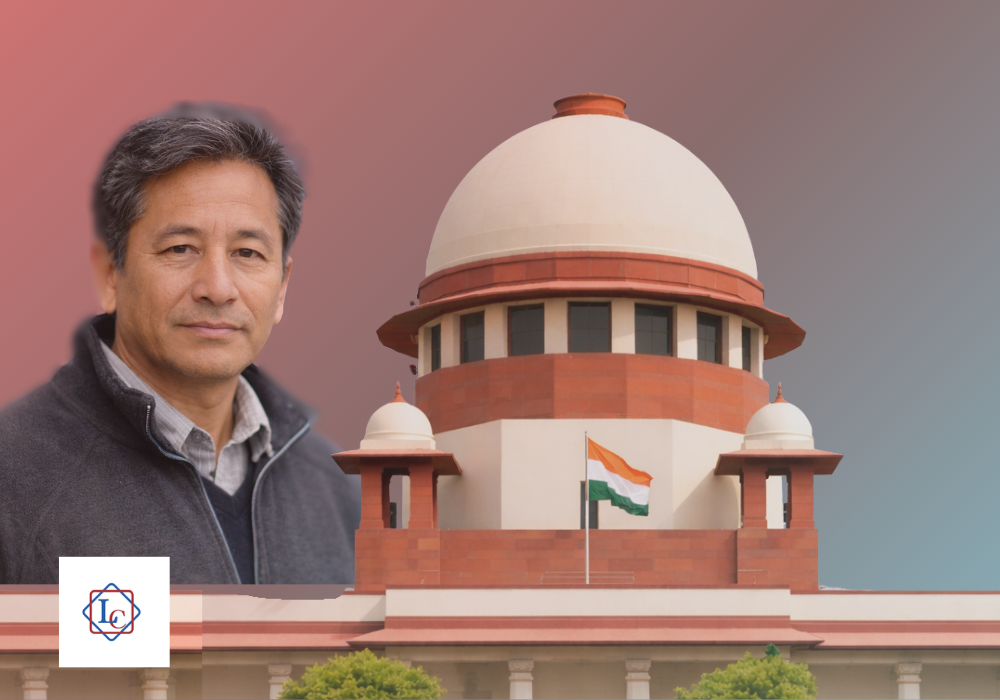
The Supreme Court on Wednesday questioned the Centre’s reading of climate activist Sonam Wangchuk’s speeches, observing that the government was “reading too much” into his statements. The Union opposed his release on medical grounds, stating he is “fit, hale and hearty”.
The Supreme Court on Wednesday (February 11, 2026), questioned the nexus between Ladakh-based climate activist Sonam Wangchuk’s speeches and the violence that broke out in Leh in September 2025, observing that the Central government was “reading too much” into his remarks.
The Bench comprising Justice Aravind Kumar and Justice P.B. Varale was hearing a habeas corpus petition filed by Wangchuk’s wife, Dr Gitanjali Angmo, challenging his detention under the National Security Act, 1980 as illegal.
At the outset, Solicitor General Tushar Mehta informed the Court that the Union Government had given utmost consideration to the Court’s earlier suggestion to review Wangchuk’s detention on health grounds, but his release would not be possible.
Mehta submitted that Wangchuk had been medically examined 28 times as per the Jail Manual and was “fit, hale and hearty”. He acknowledged that the activist had developed some digestive issues but stated he was receiving treatment. “There is nothing to worry. Nothing alarming,” Mehta told the Bench, adding that exceptions cannot be made in preventive detention matters.
Additional Solicitor General KM Nataraj, continuing arguments for the Centre, submitted that Wangchuk had acted as the “chief provocateur” in the violent protests and had instigated youth by citing examples of unrest in Nepal.
The ASG read from Wangchuk’s speeches where the activist had spoken about youth losing faith in peaceful methods and warned of the possibility of violent agitation similar to Nepal. Nataraj contended that the detention was based on four separate incidents, each constituting an independent ground, and that even if one ground were to fail, the detention order would remain sustainable.
The Court, however, questioned this interpretation. When Nataraj submitted that Wangchuk had warned that violent agitation like Nepal could happen in India, Justice Varale responded that the activist appeared to be expressing concern rather than incitement.
“He is saying that the youth is saying that. You please read the complete sentence. Here he is saying this is something worrying,” Justice Varale observed, noting that Wangchuk’s focus was on people abandoning Gandhian peaceful ways, which he found worrying. Justice Kumar remarked that the Centre was engaging in “too much of reading into it”.
Nataraj maintained that in preventive detention matters, even suspicion was sufficient and that Wangchuk’s public fasting and speeches had to be viewed collectively.
He pointed to a video uploaded on Wangchuk’s YouTube channel on June 8, 2025, where the activist had allegedly made references to an “Arab Spring” style revolution. The ASG further submitted that Wangchuk, while stationed in a sensitive border area, had compared the domestic situation to that of Pakistan and China. The Centre also argued that Wangchuk had referred to the Central government as “them”, which it characterised as revealing secessionist tendencies.
Also read: UGC equity regulations 2026 controversy: explained
Solicitor General Mehta objected to any comparison between Wangchuk and Mahatma Gandhi during the proceedings. “Let us not glorify something which is completely anti-India with the father of the nation. Let it not become tomorrow’s headline that your lordships compared the Petitioner to Gandhiji,” Mehta submitted. The Court clarified that the reference to Gandhi’s speeches was only for contextual comparison and not intended to draw parallels. Justice Kumar responded that the Court was not concerned with what happens outside the courtroom.
Background of the case
Wangchuk was detained on September 26, 2025, two days after violent protests demanding statehood and Sixth Schedule status for Ladakh left four people dead and over 90 injured in the Union Territory. The government has accused him of inciting the violence through his speeches and social media posts. He is currently lodged in Jodhpur Central Jail, Rajasthan. His wife, in her plea filed through Advocate on Record Dr Sarvam Ritam Khare, has challenged the detention as illegal and sought his immediate release, contending that it violates his fundamental rights under Article 22 of the Constitution.
Senior Advocate Kapil Sibal, appearing for Angmo, had earlier argued that four videos dated September 24, 2025, which form the core basis of the detention, were never supplied to Wangchuk, thereby depriving him of his right to make an effective representation. He had also submitted that the video showing Wangchuk appealing for peace after the violence was not placed before the detaining authority. The matter was listed for further hearing on Thursday at 2 PM.
Case details: Gitanjali J. Angmo v Union of India and Ors | W.P.(Crl.) No. 399/2025
Click here to read Order.


Leave a Reply