
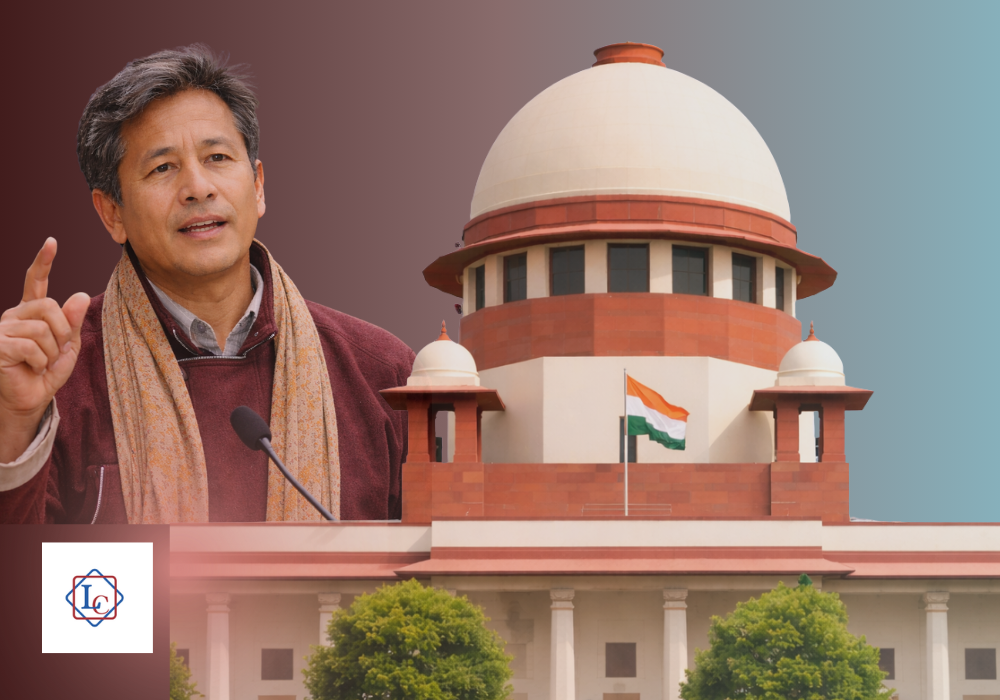
The Supreme Court on Thursday questioned whether videos relied upon for Sonam Wangchuk’s detention were actually shown to him, as petitioner’s counsel alleged that four critical videos were missing from the pen drive supplied to the activist.
Report:
The Supreme Court on Thursday (February 12, 2026), questioned whether the videos relied upon for the detention of Ladakh-based climate activist Sonam Wangchuk under the National Security Act were actually shown to him on the day of his arrest.
A Bench comprising Justice Aravind Kumar and Justice P.B. Varale was hearing the habeas corpus petition filed by Wangchuk’s wife, Dr Gitanjali Angmo, challenging his detention as illegal. The matter was adjourned to Monday, February 17 at 2 PM. Angmo was present in Court during the hearing.
Senior Advocate Vivek Tankha, appearing for Angmo, submitted that Wangchuk was a “pious man, real Gandhian” who thinks spiritually and had consistently advocated for non-violent methods.
Tankha told the Court that when other people spoke about uprising, Wangchuk had maintained that India is a non-violent country and the movement must follow the Gandhian way.
Addressing a particular statement attributed to the activist, Tankha clarified that the context pertained to whether Kargil wanted to be part of Ladakh or Kashmir, and Wangchuk had merely responded that people could go to Kashmir if they wished. “What is written in the detention order is different and the video is different,” Tankha submitted.
Counsel for Angmo raised the issue of four videos mentioned in Annexure A of the detention order, contending that the pen drive supplied to Wangchuk “mischievously” did not contain these videos. The counsel submitted that the laptop was first provided to Wangchuk on October 5, and it was then that they realised the four videos were missing.
“We have repeatedly told them about it. We are not alleging non-supply of the remaining videos. But the 4 videos referred in Annexure A were not there in that pen drive,” the counsel argued.
The Bench raised concerns about the procedural aspects of the detention order. Examining the original records, the Court observed that the endorsement only indicated that Wangchuk had received a pen drive but did not disclose whether he had an occasion to see the videos.
“If you have shown these videos then you could have drawn a statement to that effect and obtained his sign,” the Bench remarked.
When the Court asked Additional Solicitor General KM Nataraj whether anything showed that the videos were actually shown to Wangchuk on September 26, 2025, Nataraj responded that there was a separate video recording of the process.
The Bench also noted that the annexures to the detention order were unsigned, with no signatures on each page.
The Court sought original records from the Centre, observing that the SSP’s recommendation to the District Magistrate could not be a photocopy. The original documents were subsequently provided to the Court. ASG Nataraj submitted that the detention order was not a copy-paste of the SSP’s proposal and showed clear application of mind by the detaining authority.
Nataraj, concluding his submissions for the Centre, argued that a detention order can be passed on suspicion and reasonable probability. He submitted that a single incident was sufficient to pass a detention order and there was no requirement to record each and every ground. The ASG contended that each activity mentioned in the detention order was independent and constituted a separate ground for detention.
He pointed out that immediately after the detention, the agitation came under control, and had the order not been passed, it would have caused further damage.
The ASG maintained that all procedural requirements guaranteed to Wangchuk had been meticulously complied with and that all 23 videos relied upon for detention had been supplied with acknowledgment.
“The only protection to a detenu is procedural safeguards alone, nothing else,” Nataraj submitted. Referring to the sensitive location of Ladakh, he urged the Court that national interest should be paramount for every citizen in a border area where violence was erupting.
Wangchuk was detained on September 26, 2025, two days after protests demanding statehood and Sixth Schedule status for Ladakh turned violent, leaving four people dead and over 90 injured. The government has accused him of inciting the violence. He remains lodged in Jodhpur Central Jail, Rajasthan. Senior Advocate Kapil Sibal, along with Senior Advocate Vivek Tankha, is representing Angmo in the matter, while Solicitor General Tushar Mehta and ASG KM Nataraj are appearing for the Centre and Ladakh administration.
Case Details: Gitanjali J. Angmo v Union of India and Ors | W.P.(Crl.) No. 399/2025
Click here to read Order.


Leave a Reply