
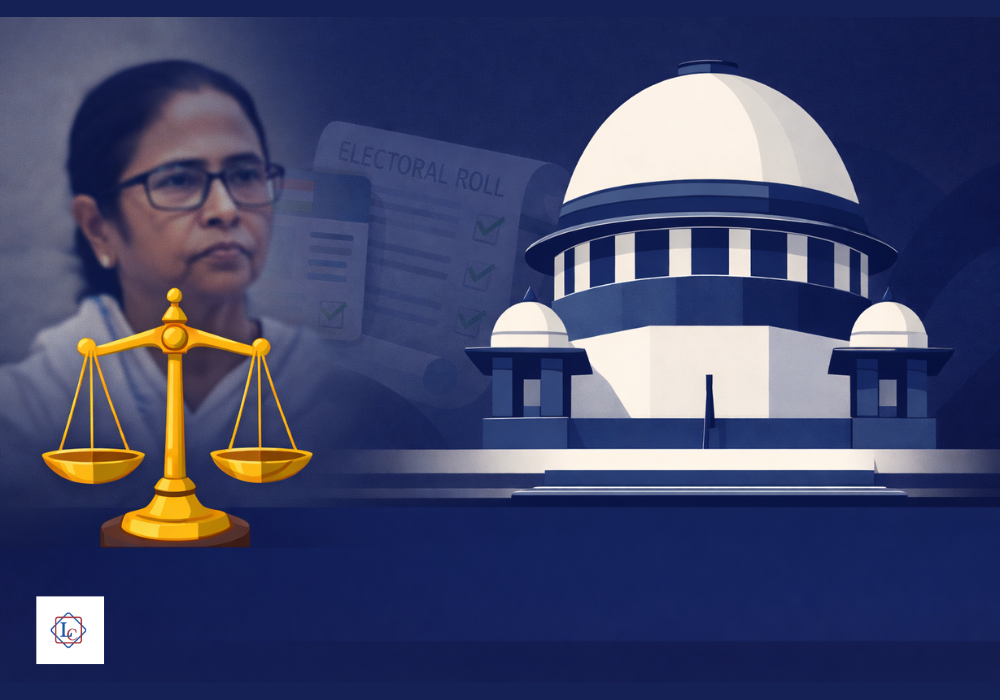
The Special Intensive Revision of electoral rolls in West Bengal has led to a constitutional clash between the State government and the Election Commission of India. Chief Minister Mamata Banerjee criticises the process as flawed, alleging irregularities and targeting of voters, while the Election Commission asserts its constitutional duty to ensure accurate electoral rolls. Legal proceedings are ongoing.
The Special Intensive Revision (SIR) of electoral rolls in West Bengal has escalated into a significant constitutional confrontation between the State government and the Election Commission of India. The Election Commission maintains it is discharging a “constitutional duty” under Article 326.
What is Article 326?
Article 326 of the Constitution provides for universal adult suffrage and states that every person who is a citizen of India and is not less than 18 years of age shall be entitled to be registered as a voter.
The ECI’s argument is that under Article 326, only citizens can vote, and therefore the Commission has a “constitutional duty” to verify citizenship for inclusion in electoral rolls.
On the other hand, In a letter dated January 3, 2026 to CEC Gyanesh Kumar, Mamata Banerjee called the process ‘arbitrary and flawed’ and accused the Commission of presiding over an ‘unplanned, ill-prepared and ad hoc’ exercise.”
Quotes from letter:
“There are also grave allegations regarding the backend deletion of electors through the misuse of IT systems, without following due process and without the knowledge or approval of the Electoral Registration Officers (EROs), who are the competent statutory authorities under the Representation of the People Act. This raises serious questions as to who has authorised such actions and under what legal authority. The ECI must be held fully accountable for any illegal, arbitrary or biased actions carried out under its supervision or direction.”
The matter has acquired additional complexity following Chief Minister Mamata Banerjee’s decision to appear in person and argue her case, a step unprecedented for a sitting Chief Minister. At stake are questions concerning electoral integrity, federal relations, and the limits of executive engagement with judicial proceedings.
The legal framework underpinning the SIR derives from Article 324 of the Constitution, which vests the superintendence, direction, and control of electoral rolls in the Election Commission.
What is Article 324?
Article 324 of the Constitution vests the “superintendence, direction and control” of elections in the Election Commission of India. It empowers the Commission to conduct elections to Parliament, State Legislatures, and to the offices of President and Vice-President.
Sections 15, 21, and 23 of the Representation of the People Act, 1950 further empower the Commission to prepare and revise these rolls through intensive or summary revision. It was pursuant to these provisions that Chief Election Commissioner Gyanesh Kumar announced on October 27, 2025 that an intensive door-to-door verification exercise would be conducted across several states, including West Bengal, ahead of the 2026 Assembly elections.
The exercise commenced on November 4, 2025. A draft electoral roll was published on December 16, 2025, with the final roll originally scheduled for publication on February 14, 2026. The Commission’s decision to flag approximately 1.36 crore voters under a category termed “logical discrepancy” triggered immediate resistance from the ruling Trinamool Congress.
The party alleged that the exercise was designed not for inclusion of voters but for their systematic deletion, claiming that 58 lakh names had been struck off in the first phase alone.
Chief Minister Banerjee’s response was swift. On January 3, 2026, she wrote to the Chief Election Commissioner demanding an immediate halt to the process. Her letter described the SIR as “arbitrary and flawed,” accusing the Commission of overseeing an “unplanned, ill-prepared, and ad hoc” exercise marked by “serious irregularities, procedural violations, and administrative lapses.” The Commission, for its part, maintained that it was discharging its constitutional mandate and that the revision was necessary to ensure accurate electoral rolls.
The dispute soon reached the Supreme Court. TMC Members of Parliament Derek O’Brien and Dola Sen filed petitions challenging the SIR process, and on January 12, 2026, a Bench led by Chief Justice Surya Kant sought the Election Commission’s response.
The Court observed: “See the strain and stress going on for ordinary people. Over one crore people have been issued notices…we are going to pass some orders.”
The Court’s first substantive intervention came on January 19, 2026 in Mostari Banu v. Election Commission of India (2026). Recognising the practical difficulties faced by voters required to travel to distant Block Development Offices, the Court directed that names in the “logical discrepancy” list be displayed at panchayat offices. It further permitted authorised representatives to attend hearings on behalf of voters and granted a ten-day extension beyond the original deadline.
These directions addressed procedural concerns but did not resolve the substantive challenge to the SIR itself. That challenge acquired a new dimension on January 28, 2026, when Chief Minister Banerjee filed a writ petition under Article 32 of the Constitution in her personal capacity.
What is Article 32?
Article 32 of the Constitution guarantees the right to move the Supreme Court for the enforcement of fundamental rights. It empowers the Court to issue directions, orders, or writs, including habeas corpus, mandamus, prohibition, quo warranto, and certiorari, for the protection of these rights.
The petition, registered as W.P.(C) No. 129/2026, named the Election Commission and the West Bengal Chief Electoral Officer as respondents. It sought the quashing of all SIR-related orders issued on June 24, 2025 and October 27, 2025, and prayed that the 2026 Assembly elections be conducted on the basis of the existing 2025 electoral rolls.
Accompanying the petition was an interlocutory application seeking permission to appear and argue in person. Banerjee, who holds a law degree from Jogesh Chandra Choudhury College of Law, Calcutta, had last practised as an advocate in 2003. Her decision to appear personally before the Court was without precedent for a sitting Chief Minister.
The hearing on February 4, 2026 drew national attention. A Bench comprising Chief Justice Surya Kant, Justice Joymalya Bagchi, and Justice NV Anjaria heard the matter. Banerjee, seated in Courtroom 1 alongside Senior Advocates Kapil Sibal and Shyam Divan, was permitted to supplement her counsel’s submissions. She wore a black shawl but not the black gown traditionally worn by advocates.
Her submissions were direct. She contended that West Bengal was being “targeted” by the SIR process and questioned why similar exercises were not being conducted in Assam or the Northeast. She alleged that the revision was designed for deletion rather than inclusion, citing instances of women whose names had been struck off after changing surnames following marriage, and of living persons mistakenly declared dead. She stated that over 100 people, including Booth Level Officers, had died during the exercise.
Banerjee also raised concerns regarding the appointment of approximately 8,000 micro-observers from BJP-ruled states. She described the Election Commission as a “WhatsApp Commission” that issued informal instructions rather than formal orders, and stated that six letters addressed to the Commission had gone unanswered. Quoting Rabindranath Tagore, she told the Court: “When justice is crying behind the door…then we thought we are not getting justice anywhere. We wrote 6 letters to the election commission. I am a bonded labour…I prefer that, I am not fighting for my party.”
The Election Commission’s response, presented by Senior Advocate Rakesh Dwivedi, contested these allegations. Dwivedi submitted that micro-observers had been appointed because the State government had failed to provide sufficient Group B officers despite repeated reminders. He stated that only lower-ranked government employees such as Anganwadi workers had been made available, and that the micro-observers were validly appointed under the Representation of the People Act.
Also read: UGC Equity Regulations 2026 Controversy: Explained
Solicitor General Tushar Mehta, appearing for the Union, alleged that there was an “atmosphere of hostility” towards ECI officials in West Bengal. The Commission’s affidavit went further, alleging that Banerjee had conducted a press conference on 14 January 2026 in which she engaged in “fear-mongering” and disseminated “misleading and erroneous information.” It accused her of publicly identifying and targeting a micro-observer named Hari Das, subjecting him to “unwarranted pressure and intimidation.”
Chief Justice Surya Kant, while hearing the submissions, observed: “State of West Bengal in its own right has also filed a writ petition. One of the best counsels are there in SC to represent the case of the state. Mr Divan, Mr Sibal and best of best are there to assist us.”
The Court also engaged with the linguistic complexities of the SIR. Justice Bagchi, himself from West Bengal, noted that Bengali has no “va” sound, which could result in spelling variations.
Referring to this, Chief Justice Surya Kant observed: “I had the advantage of my two brothers from West Bengal. They told me how pass certificates are issued and that is why we included it.” He further stated: “If state provides a team well conversant in Bangla and tell the commission that it is local dialect mistake…then it will help them. It is apparent in some cases.”
The Court also directed the Commission to exercise caution in issuing notices, observing: “Please send notices carefully. You cannot put out notable authors etc.”
The Court issued notice to the Election Commission and directed it to respond by February 9, 2026. It indicated that if the State provided sufficient Group B officers, the micro-observers could be relieved.
A further development occurred on February 8, 2026, when Satish Kumar Aggarwal, former Vice-President of the Akhil Bharat Hindu Mahasabha, filed an intervention application challenging the propriety of Banerjee’s personal appearance. The application contended that the petition was not a personal dispute but concerned matters of State governance and the constitutional relationship between West Bengal and the Election Commission. It argued that the Chief Minister could not claim to appear in a personal capacity when the State was already represented by counsel.
The application described the personal appearance as “constitutionally improper, institutionally undesirable, and legally untenable.” It stated that constitutional functionaries are expected to conduct cases through legal counsel to preserve the dignity and independence of courts.
Permitting such an appearance, the applicant argued, carried the risk of “symbolic pressure” and “institutional imbalance.”
Also read: Doctrine of basic structure
The application also questioned the maintainability of the petition under Article 32, arguing that the Chief Minister had not demonstrated any infringement of her fundamental rights.
The question of whether a sitting Chief Minister can appear as petitioner-in-person is not straightforward.
Under the Advocates Act, 1961, any person may appear before a court as a party-in-person. This right is fundamental and cannot ordinarily be denied. The intervention application, however, draws a distinction between ordinary litigants and constitutional functionaries. It relies on precedents differentiating between a Chief Minister, who is the executive head of government and draws remuneration from the public exchequer, and ordinary legislators.
The intervention application filed by Satish Kumar Aggarwal contended that Banerjee’s appearance amounted to an abuse of procedure, arguing that the use of the petitioner-in-person label while being represented by senior advocates served purposes beyond seeking legal remedy.
When the hearing on the same matter again commenced, Banerjee did not appear in person. The Court made clear that no impediment would be permitted in the conduct of the SIR.
Chief Justice Surya Kant stated that the process must be understood and respected by all states. The Court directed that more than 8,000 officers whose names had been provided be present before respective District Electoral Officers by 5 PM the following day.
Counsel for the State informed the Court that West Bengal would make 8,505 Group B officers available to oversee the process. The Court granted an additional week beyond the 14 February deadline for scrutiny of names by Electoral Registration Officers. It also directed the West Bengal Director General of Police to file a personal affidavit addressing allegations of hostility towards election officials.
The Supreme Court has reserved judgment on the petitions challenging the legality of the SIR. That decision will determine the scope of the Election Commission’s powers under Article 324 to conduct intensive revision exercises. The intervention application challenging Banerjee’s personal appearance also remains pending, and any ruling on that issue could establish precedent for how constitutional functionaries engage with judicial proceedings.
The final electoral roll for West Bengal, originally scheduled for 14 February 2026, has been delayed. The outcome of the SIR will have direct implications for the 2026 Assembly elections.
Cases: (1) Mostari Banu v. The Elections Commission of India and Ors., W.P.(C) No. 1089/2025;
(2) Joy Goswami v. Election Commission of India and Anr., W.P.(C) No. 126/2026;
(3) Mamata Banerjee v. Election Commission of India and Anr., W.P.(C) No. 129/2026;
(4) Sanatani Sansad and Anr. v. Election Commission of India and Ors., W.P.(C) No. 1216/2025


One response to “Explained: The West Bengal SIR controversy and Mamata Banerjee’s unprecedented Supreme Court appearance”
[…] Also read: Explained: The West Bengal SIR controversy and Mamata Banerjee’s unprecedented Supreme Court appea… […]