
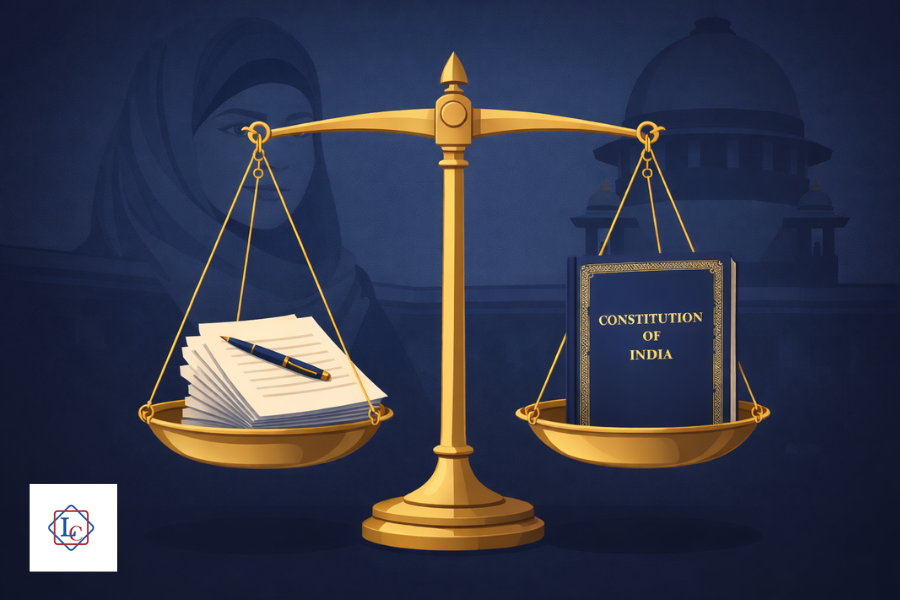
Chief Justice of India Surya Kant observed that a Uniform Civil Code is the answer to addressing discriminatory inheritance provisions under Muslim personal law, while cautioning against hasty judicial intervention that could create a legal vacuum and inadvertently deprive Muslim women of existing rights.
THE Supreme Court on Tuesday heard a writ petition challenging discriminatory inheritance provisions under Muslim personal law, with Chief Justice of India Surya Kant remarking that a Uniform Civil Code is the answer, while cautioning that hasty judicial reforms could inadvertently leave Muslim women worse off than they currently are.
A Bench comprising Chief Justice of India Surya Kant, Justice Joymalya Bagchi and Justice R. Mahadevan was hearing a petition filed by Advocate Poulomi Pavini Shukla along with the Nyaya Naari Foundation, represented by Aisha Jawaid.
The petition challenged provisions of the Muslim Personal Law (Shariat) Application Act, 1937, arguing that they discriminate against Muslim women by granting them only half the inheritance share that male heirs receive.
Advocate Prashant Bhushan, appearing for the petitioners, submitted that the Shariat inheritance provisions create artificial discrimination between genders and should be tested against Article 14 of the Constitution.
He relied on the 2017 judgment of the Supreme Court in the Shayara Bano case, which struck down triple talaq as unconstitutional, to argue that the Court can interfere with discriminatory personal law practices.
He contended that, “We cannot have a situation in the country now after the Shayara Bano judgment that Muslim women will not have same rights as Muslim men.”
Also read: Supreme Court grants anticipatory bail to folk singer Neha Singh Rathore, makes it absolute
Bhushan further argued that inheritance is a civil right and not an essential religious practice protected under Article 25 of the Constitution.
Should the 1937 Act be struck down, he submitted, the provisions of the Indian Succession Act, 1925, would apply to fill any resulting vacuum. He also cited the Mary Roy case, where the Supreme Court addressed a similar conflict between a state law and the Indian Succession Act regarding Christian women’s inheritance rights in Kerala.
The Bench, however, raised significant concerns about the consequences of striking down the Shariat inheritance provisions without a statutory replacement.
Justice Bagchi referred to the Bombay High Court’s decision in State of Bombay v. Narasu Appa Mali, which held that personal laws cannot be subjected to constitutional tests.
He questioned whether, even if the 1937 Act were struck down, Muslim inheritance would not continue to be guided by personal law acknowledged under Article 372 of the Constitution.
CJI Surya Kant expressed particular concern about the practical consequences of judicial intervention. He observed that, “In our over-anxiety for reforms, we may end up depriving them and they might end up getting less than what they are already getting. If the Shariat Act 1937 goes away, then what is the question? Will it not create an unnecessary void?”
Also read: UGC equity regulations 2026 controversy: explained
The Chief Justice also questioned whether the Indian Succession Act would automatically apply to Muslims if the 1937 Act were invalidated, asking Bhushan to confirm the legal position on this point.
Justice Bagchi noted that in the Shayara Bano judgment itself, the judges had taken different approaches. While Justice Nariman held that the 1937 Act crystallises a statutory recognition of pre-existing personal law, Chief Justice Khehar took a different view on how personal law should be tested against constitutional provisions.
Acknowledging the strength of the discrimination argument, Justice Bagchi suggested that the matter was best left to legislative action. He remarked that, “You have a very good case on discrimination, but would it not be appropriate for the court to defer it to the wisdom of the legislature, which has the mandate to enact a Uniform Civil Code as per the Directive Principles of State Policy.”
Taking this cue, CJI Surya Kant declared that, “The answer is Uniform Civil Code.”
Justice Bagchi further pointed out that the principle of monogamy is not being uniformly applied across all communities. He questioned whether the Court could declare all bigamous marriages unconstitutional, observing that, “But does that mean that the Court can declare all bigamous marriages as unconstitutional? So we have to defer to legislative power to bring the directive principles in effect.”
He added that, “It is best to defer it to legislative wisdom. This court has already recommended to the legislature to enact a Uniform Code.”
Justice Bagchi also observed that numerous “oases of asymmetry” exist in various personal laws, including those involving rights of Scheduled Tribes, suggesting that a comprehensive legislative approach would be more appropriate than piecemeal judicial intervention.
The petition had highlighted that the enactment of the Uttarakhand Uniform Civil Code, 2024, has created two distinct regimes of civil rights within the Muslim community. A Muslim woman residing in Uttarakhand now enjoys equal inheritance rights with her brothers, while a Muslim woman in other states continues to inherit only half the share of a male sibling under the Shariat Act.
The petitioner sought a declaration that section 2 of the Muslim Personal Law (Shariat) Application Act, 1937, insofar as it governs intestate succession and inheritance, is void under Articles 13, 14, 15 and 21 of the Constitution to the extent that it discriminates against Muslim women by denying them equal shares in inheritance.
Shukla pointed out in her petition that equal inheritance rights have already been secured for Hindu daughters under the Hindu Succession Act, 1956 (as amended in 2005), and for Christian and Parsi women under the Indian Succession Act, 1925.
The Bench indicated that judicial intervention would be more appropriate in a petition filed by Muslim women themselves seeking to be exempted from the Shariat Act. CJI Surya Kant observed that, “Ideally, Mr. Bhushan, if a platform like a Waqf Board or a welfare association represented by Muslim women came forward saying, ‘We want to wriggle out of the 1937 Act; even if we get nothing, we want to be free of this discriminatory legislation,’ that would be one way of dealing with it.” Bhushan clarified that some of the petitioners are indeed Muslim women.
The Court directed the petitioner to amend the petition to include suggestions regarding remedies that should apply if the Shariat inheritance provisions are struck down. The matter has been adjourned for four weeks to allow for the filing of the amended petition.
This is not the first time the Supreme Court has been called upon to address personal law reforms. Article 44 of the Constitution, which falls under the Directive Principles of State Policy, directs the State to endeavour to secure a uniform civil code for all citizens.
In Shah Bano’s case in 1985, a Constitution Bench observed that a common civil code would help the cause of national integration by removing disparate loyalties to laws with conflicting ideologies.
The Court has repeatedly urged Parliament to act on this constitutional directive, with various benches over the decades lamenting that Article 44 has remained in “cold storage” since 1949.
Case title: Poulomi Pavini Shukla v. Union of India (Diary No. 67256/2025)


Leave a Reply