
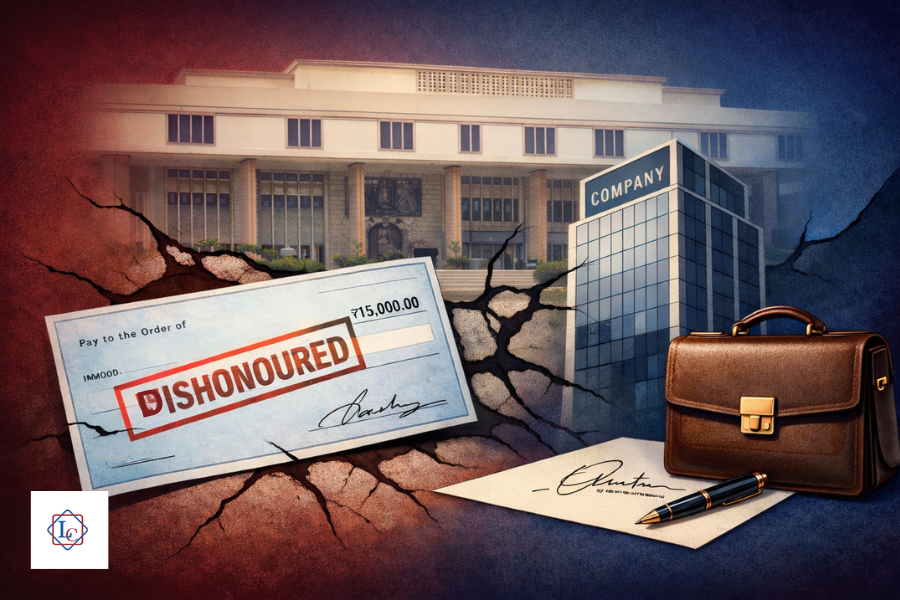
The Delhi High Court has held that in a cheque dishonour case, where the cheque is linked to a personal guarantee for corporate obligations, it cannot be inferred at the summoning stage that the cheque was not issued in discharge of the company’s debt.
THE Delhi High Court has recently held that a company cannot automatically escape liability in a cheque dishonour case merely because the cheque in question was issued from the personal bank account of one of its directors.
Justice Anup Jairam Bhambhani dismissed a petition filed by SRK Devbuild Pvt Ltd seeking to quash a summoning order issued by a trial court in proceedings under section 138 of the Negotiable Instruments Act, 1881.
The court observed that where such a cheque is connected to a personal guarantee given for the company’s obligations, it cannot be concluded at the preliminary stage that the cheque was not issued in discharge of the company’s liability.
The ruling came in a case where the petitioner company, now under liquidation, had challenged a summoning order dated August 23, 2018 passed by the Metropolitan Magistrate at Patiala House Courts. The criminal complaint had arisen after a cheque worth Rs 2 crore dated June 5, 2018 was dishonoured.
Counsel appearing for the petitioner company argued that SRK Devbuild should not have been arrayed as an accused since the cheque had been issued from the personal bank account of one of its directors, Subhash Chand Aggarwal, and not from the company’s account.
The petitioner contended that no specific allegations in the complaint attributed liability to the company. Reliance was placed on the Supreme Court’s judgment in Pepsi Foods Ltd. v. Special Judicial Magistrate, which emphasises that criminal courts must carefully examine allegations before summoning an accused.
The petitioner further submitted that the company had entered the Corporate Insolvency Resolution Process in January 2020 and was subsequently ordered to be liquidated in February 2021.
In view of section 33(5) of the Insolvency and Bankruptcy Code, 2016, the institution of any suit or other legal proceedings against the company was barred, the petitioner argued.
The respondent opposed the petition and submitted that the cheque represented a composite liability arising out of commercial dealings involving the company. The director had issued the cheque in discharge of legally enforceable obligations arising from agreements between the parties and from a Personal Guarantee Deed executed on March 31, 2017, the respondent contended.
The respondent further pointed out that the accused persons had repeatedly defaulted in appearing before the trial court during the proceedings, which eventually led the court to issue both bailable and non-bailable warrants against them.
Justice Bhambhani closely scrutinised the connection between the director’s personal account and the company’s liability. The court noted that the cheque had been issued in terms of the personal guarantee furnished by the director in relation to the company’s obligations.
The court observed that, “The subject cheque, though admittedly drawn on the personal account of one of the directors-Mr. Subhash Chand Aggarwal, was drawn inter alia in accordance with the Deed of Personal Guarantee dated 31.03.2017… Therefore, it is not possible to infer, least of all at this stage, that the subject cheque was not issued in discharge of a debt or liability owed by the petitioner-company.”
On the question of the company’s insolvency proceedings, the court noted that these developments had occurred nearly two years after the cheque had been issued and dishonoured.
The court stated that, “The liability of the petitioner-company under section 138 of the NI Act… arose well before the CIRP or liquidation proceedings, and therefore, whether or not that liability would be effaced by subsequent events, would have to be seen in the course of the trial.”
The court referred to several Supreme Court judgments while discussing the scope of a Magistrate’s powers at the stage of issuing summons.
Relying on decisions including Mehmood Ul Rehman v. Khazir Mohammad Tunda and Sunil Todi v. State of Gujarat, the court explained that a Magistrate must be satisfied that a prima facie case exists but is not required to conduct a detailed examination of evidence at that stage.
The court clarified that, “Though the Magistrate is required to consider the averments in the complaint… the Magistrate is not required to give detailed reasons at the stage of issuing summons in proceedings under section 138 of the NI Act.”
After examining the record, the court observed that although the Magistrate’s summoning order was brief and did not elaborate on all the ingredients of the offence, the documents placed on record, including the complaint, the subject cheque, the dishonour memo, and the statutory notice, were sufficient to disclose a prima facie case.
The court ruled that, “In the present case, though the Magistrate has omitted to narrate in the impugned summoning order as to how a prima-facie case is made-out… this court would refrain from interfering with the impugned summoning order, though the ingredients of the offence do not find any mention in it.”
The court dismissed the petition and vacated the stay that had earlier been granted on the trial court proceedings. The matter will now continue before the trial court in accordance with law.
Case title: SRK Devbuild Pvt Ltd Through Its Liquidator Mr. Ravi Kapoor v. Government of NCT of Delhi & Anr., CRL.M.C. 5337/2024
FAQs
Can a director be held liable for cheque bounce if they did not sign the cheque?
A non-signatory director cannot be held liable under section 138 of the NI Act unless the complaint specifically alleges they were “in charge of and responsible for” the company’s business at the time of the offence. The Supreme Court has clarified that merely naming someone as a director is not sufficient to establish liability; specific factual allegations regarding their role and responsibility must be included in the complaint.
Is a company liable for cheque bounce if the cheque was issued from a director’s personal account?
A company may still be liable for cheque dishonour even if the cheque was drawn from a director’s personal bank account, provided the cheque is linked to a personal guarantee for the company’s obligations. Courts have held that where such a connection exists, it cannot be inferred at the summoning stage that the cheque was not issued in discharge of the company’s debt.
Can directors escape liability under section 138 if the company goes into insolvency after cheque dishonour?
Directors cannot escape liability merely because the company subsequently entered insolvency proceedings if the cheque was issued and dishonoured before the Corporate Insolvency Resolution Process commenced. Courts have held that liability under section 138 arises at the time of dishonour, and subsequent insolvency proceedings cannot automatically efface liability that arose earlier.
Are independent or non-executive directors liable for cheque bounce under section 141 of the NI Act?
Independent or non-executive directors who are not involved in the company’s day-to-day affairs cannot be held vicariously liable for cheque dishonour. The Supreme Court has ruled that liability under section 141 depends on the role one plays in the affairs of a company, not on designation or status alone; directors not in charge of or responsible for the conduct of business at the relevant time are not liable.
Can a director who resigned before the cheque was issued be held liable under section 138?
A director who resigned before the issuance of a cheque cannot be held liable for its dishonour, even if the underlying debt arose during their tenure. The Supreme Court has clarified that section 141 applies only to individuals who were in charge of and responsible for the company’s business at the time the offence was committed, shielding former directors from liability for offences committed after their resignation.


Leave a Reply