
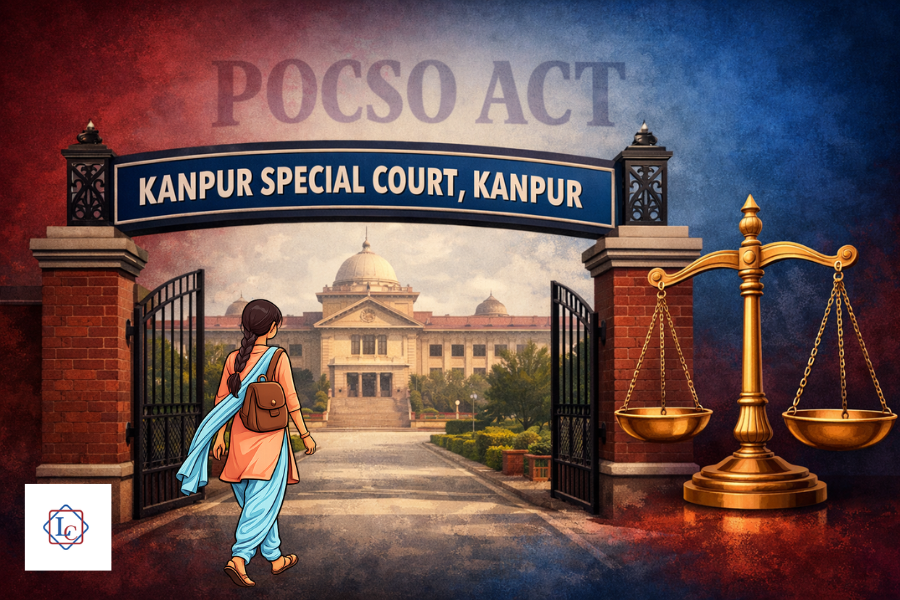
A special court in Kanpur has acquitted an Indian Air Force personnel of POCSO charges after the minor complainant retracted her allegations during trial, stating the incident she perceived as molestation was a dream induced by medication. The prosecution failed to prove the case beyond reasonable doubt.
A special court in Kanpur has acquitted an Indian Air Force personnel accused of molesting his minor sister-in-law after the complainant told the court during trial that the alleged incident was merely a dream she experienced while semi-conscious on medication.
Special Judge Rashmi Singh acquitted Anurag Shukla of all charges under the Protection of Children from Sexual Offences Act, 2012 on March 7, 2026, holding that the prosecution had failed to prove the case beyond a reasonable doubt. The acquittal came nearly seven years after the FIR was registered at Naubasta Police Station, Kanpur, on August 3, 2019.
The complainant, who was 15 years old at the time of the alleged incident, had accused Shukla of molesting her on the night of March 8, 2019, while she was staying at her sister’s house in Khadepur. Shukla had married the complainant’s elder sister, Shivani Tiwari, barely a month earlier on February 10, 2019.
During the trial, however, the complainant’s testimony took a different turn. She told the court that she had been on antibiotics that night and was in a semi-conscious state when she felt, in a dream, that Shukla had grabbed and molested her. Waking up frightened, she raised an alarm, and the subsequent complaint was filed under what her family later acknowledged as a misunderstanding.
The complainant’s father, Vijay Tiwari, and her elder sister Shivani also testified before the court, confirming that the complaint had been lodged under a misunderstanding and that no actual incident had taken place. Defence counsel Karim Ahmad Siddiqui told PTI that the retraction by the complainant and the corroborating statements from family members led the court to conclude that the prosecution’s case could not be sustained.
Also read: Personality rights and John Doe orders: Why celebrities are rushing to courts
Shukla was arrested on September 29, 2019, and spent 19 days in judicial custody before being granted bail on October 17, 2019. A chargesheet was filed subsequently, and the special court framed charges in November 2019 under provisions relating to molestation and sexual assault of a minor under POCSO.
Speaking after the acquittal, Shukla said the case had caused him severe mental stress and harmed his social reputation. He claimed that his career in the IAF had suffered as a result, stating that he could not secure a promotion to the rank of corporal in 2020 and continues to serve as a leading aircraftman.
FAQs
What is the standard of proof required for conviction under the POCSO Act?
Under Indian criminal law, the prosecution must prove the case beyond reasonable doubt. Section 29 of the POCSO Act creates a presumption of guilt once the prosecution establishes that the accused committed the act, shifting the burden to the accused to prove innocence. However, the foundational facts, including that the alleged act actually occurred, must still be established by the prosecution through credible evidence.
What is the evidentiary value of a complainant’s retraction in POCSO cases?
A retraction by the complainant does not automatically result in acquittal. Courts examine the circumstances of both the original statement and the retraction under section 145 of the Indian Evidence Act, 1872. If the retraction is found credible and corroborated by other witnesses or circumstances, and the original complaint lacks independent corroboration, courts may acquit on the ground that the prosecution failed to discharge its burden.
Can POCSO charges be quashed based on compromise between parties?
No. The Allahabad High Court in Om Prakash vs State of UP (2023) held that offences under sections 7 and 8 of the POCSO Act are offences against society and cannot be quashed merely on the basis of compromise between the victim and the accused. The court must determine the truth of the allegations based on evidence led at trial.
What constitutes “sexual assault” under section 7 of the POCSO Act?
Section 7 of the POCSO Act defines sexual assault as touching the vagina, penis, anus, or breast of a child with sexual intent, or making the child touch such body parts of another person, or any other act with sexual intent involving physical contact without penetration. The presence of “sexual intent” is a necessary ingredient, as clarified by the Delhi High Court, which held that mere physical contact without sexual intent does not attract POCSO provisions.
What is the limitation period for filing a complaint under POCSO?
Unlike many criminal offences, there is no statutory limitation period for filing complaints under the POCSO Act. Section 19 mandates that any person who has knowledge of an offence must report it, but does not prescribe a time limit. However, unexplained delays in filing complaints may affect the credibility of the prosecution’s case and can be considered by courts while evaluating evidence.


Leave a Reply