
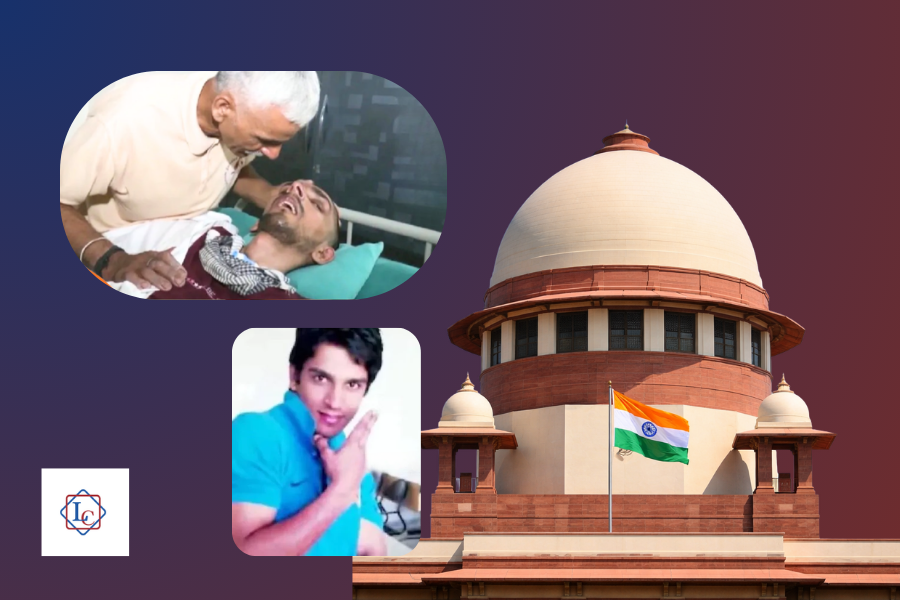
The Supreme Court has permitted the withdrawal of life support for Harish Rana, a 32-year-old man who has been in a permanent vegetative state since 2013. In its first judicial application of the 2018 Common Cause guidelines, the Court ruled that clinically assisted nutrition constitutes medical treatment and clarified that terminal illness is not a prerequisite for passive euthanasia.
THE Supreme Court on Wednesday (March 11) allowed the withdrawal of life-sustaining treatment for Harish Rana, a 32-year-old who has been in a vegetative state for over 13 years. This is the first time the court has applied its passive euthanasia framework in an individual case.
A bench comprising Justice JB Pardiwala and Justice K.V. Viswanathan allowed the plea filed by the father of Harish Rana, directing that his clinically assisted nutrition be withdrawn at the palliative care centre of AIIMS, New Delhi.
Who is Harish Rana?
Harish Rana was a 19-year-old engineering student at Panjab University when he fell from the fourth floor of his paying guest accommodation in Chandigarh in August 2013. The fall caused severe traumatic brain injury, leaving him in a persistent vegetative state with 100 per cent quadriplegia.
Quadriplegia, also known as tetraplegia, is paralysis affecting all four limbs and the torso, typically caused by spinal cord injuries at the C1-C8 cervical levels.
Medical reports placed before the Court indicated that despite more than a decade of treatment, his condition had shown no improvement. He experiences sleep-wake cycles but exhibits no meaningful interaction with his surroundings, remaining entirely dependent on clinically assisted nutrition administered through a surgically installed PEG tube, a tracheostomy tube for respiration, and requiring constant care that has resulted in significant bed sores.
The Court held that clinically assisted nutrition constitutes a technological medical intervention rather than mere basic care, and therefore falls within the passive euthanasia framework.
Noting that the continuation of treatment merely prolonged biological existence without any therapeutic improvement, Justice Pardiwala observed that, “While a doctor’s duty is to apply treatment, that duty no longer sustains when the patient has no hope of recovery and the intervention merely prolongs biological existence.”
The family’s legal journey began when Rana’s parents approached the Delhi High Court in 2024 seeking the constitution of a medical board to examine whether life-sustaining treatment could be withdrawn.
Also read: Supreme Court dismisses AI-drafted PIL on PM CARES Fund, tells Ludhiana trader to “go sell sweaters”
The High Court dismissed the petition, holding that Rana was not on mechanical life support such as a ventilator and could sustain himself without external aid. Since he was not terminally ill, the court reasoned, the question of passive euthanasia did not arise. The parents challenged this before the Supreme Court in August 2024, but the Court initially declined to grant relief whilst directing the State of Uttar Pradesh to bear the treatment expenses.
In 2025, as Rana’s condition remained unchanged and irreversible, his father filed a miscellaneous application in the disposed matter. The Court directed the constitution of a Primary Medical Board, which reported that the man was in a “pathetic condition” with negligible chances of recovery.
A Secondary Medical Board constituted by AIIMS submitted what Justice Pardiwala described as a “sad report”, prompting him to remark that, “We cannot keep this boy in this stage for all time to come.”
In his concurring opinion, Justice K.V. Viswanathan clarified that the High Court had erred in concluding that the case fell outside the scope of Common Cause because the patient was not terminally ill.
Terminal illness, the judge held, is not a prerequisite for considering withdrawal of life-sustaining treatment. A patient in a permanent vegetative state can qualify for the constitution of medical boards to assess withdrawal of treatment, even in the absence of an advance directive.
The Court laid down two key conditions that must be satisfied before withdrawing life-sustaining treatment: the intervention in question must qualify as medical treatment, and the withdrawal must be in the patient’s best interest. Both the primary and secondary medical boards, along with the patient’s parents, had unanimously concluded that the clinically assisted nutrition should be discontinued as it was not serving the patient’s best interest.
The Bench passed several directions to implement the judgment. It ordered that the medical treatment, including clinically assisted nutrition, shall be withdrawn or withheld, waiving the 30-day reconsideration period prescribed under the Common Cause guidelines given the peculiar circumstances.
AIIMS was directed to admit Rana to its palliative care centre and ensure all facilities for shifting him from his residence, with the withdrawal to be carried out through a carefully tailored plan that maintains dignity.
The Court also issued broader directions to strengthen the institutional framework for passive euthanasia cases. It directed high courts across the country to issue instructions to judicial magistrates to receive intimations from hospitals whenever Primary and Secondary Medical Boards arrive at a unanimous decision to withdraw or withhold life support.
The Union Government was directed to ensure that Chief Medical Officers in all districts maintain panels of registered medical practitioners who may be nominated to secondary medical boards. The Court further clarified that palliative and end-of-life care can be provided not only in hospitals but also at home or any place chosen by the patient or family, provided adequate medical care is ensured.
Significantly, the Bench recommended that Parliament consider enacting comprehensive legislation governing end-of-life care. The Court noted that when both primary and secondary medical boards have certified the withdrawal of life-sustaining treatment in accordance with the Common Cause guidelines, judicial intervention is not necessary. However, since this was the first instance of such an order, the reference to the Court was deemed appropriate.
Concluding the judgment, the Court acknowledged the unwavering support of the patient’s family over more than a decade. Justice Pardiwala stated that, “His family never left his side… To love someone is to care for them even in the darkest times. Our decision today may not fit neatly within logic, but it reflects the realities of love, life and loss.”
Advocate Rashmi Nandakumar appeared for the petitioner. Additional Solicitor General Aishwarya Bhati appeared for the Union of India.
Case title: Harish Rana v. Union of India | MA 2238/2025 in SLP(C) No. 18225/2024
FAQs
1. Is passive euthanasia legal in India?
Yes, passive euthanasia is legal in India following the Supreme Court’s 2018 judgment in Common Cause v. Union of India, which recognised the right to die with dignity as a fundamental right under Article 21 of the Constitution.
2. What is the difference between active and passive euthanasia under Indian law?
Passive euthanasia involves withdrawing or withholding life-sustaining treatment to allow natural death and is legally permitted, whereas active euthanasia involves deliberately administering a lethal substance to cause death and remains a criminal offence in India.
3. Is terminal illness mandatory for passive euthanasia in India?
No, the Supreme Court in Harish Rana v. Union of India (2026) clarified that terminal illness is not a prerequisite, and patients in a permanent vegetative state with no hope of recovery can also qualify for withdrawal of life-sustaining treatment.
4. What was the Supreme Court’s ruling in the Aruna Shanbaug case on passive euthanasia?
In Aruna Ramachandra Shanbaug v. Union of India (2011), the Supreme Court first permitted passive euthanasia under strict guidelines requiring high court approval, though it rejected the specific plea for Shanbaug who had been in a vegetative state for 37 years.
5. What is the procedure for passive euthanasia in India?
The procedure requires approval from a Primary Medical Board and a Secondary Medical Board examining the patient’s condition, followed by intimation to the jurisdictional Judicial Magistrate, as laid down in Common Cause v. Union of India (2018) and modified in 2023.
6. What are the guidelines for passive euthanasia under the Common Cause judgment?
In Common Cause v. Union of India (2018), a five-judge Constitution Bench recognised the right to die with dignity as a fundamental right under Article 21 and laid down a procedure for passive euthanasia. The guidelines require approval from both a Primary Medical Board and a Secondary Medical Board before life-sustaining treatment can be withdrawn. These guidelines were simplified in January 2023 to remove the earlier requirement of obtaining a Judicial Magistrate’s approval, making the process less cumbersome for terminally ill patients and those in permanent vegetative states.


Leave a Reply