
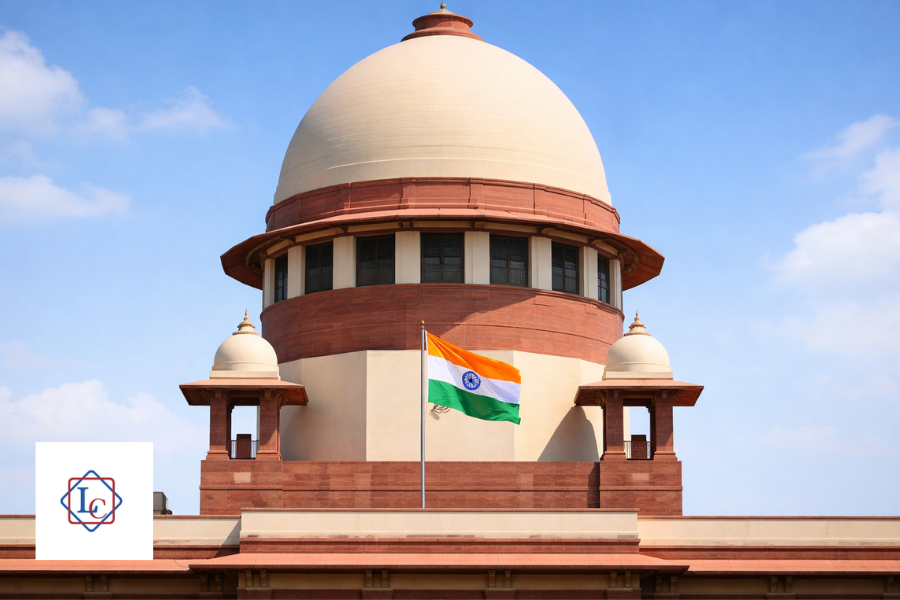
The Supreme Court held that section 173(3) BNSS required a preliminary enquiry before FIR registration in such cases, and criticised the Rajasthan Police for acting with “unusual expediency” at the behest of an influential complainant.
THE Supreme Court recently quashed an FIR registered against Ashish Dave, former Channel Head of Zee Rajasthan and Zee 24 Ghanta, in an alleged extortion case.
The Court held that the complaint filed by Zee Media Corporation Limited was a “fictional story woven meticulously on vague and speculative allegations.”
The Bench of Justices Vikram Nath and Sandeep Mehta set aside the order by Rajasthan High Court which refused to quash the FIR and, held that the continuation of proceedings would amount to an abuse of the process of law.
The case originated from a complaint filed by Zee Media through its representative Sanju Raju at Ashok Nagar Police Station in Jaipur in September 2025. The company alleged that Dave had misused his position as Channel Head to engage in unauthorised financial dealings, demanded monetary favours from external entities by threatening negative media coverage, and broadcast defamatory or coercive content to exert pressure.
It was further claimed that his actions had caused reputational and financial harm to the company. Based on these allegations, the police registered an FIR invoking provisions corresponding to extortion, cheating and criminal intimidation under the Bharatiya Nyaya Sanhita, 2023.
Dave, who was terminated during this period, challenged the FIR before the Rajasthan High Court under section 528 of the Bharatiya Nagarik Suraksha Sanhita, 2023 (BNSS) (section 482 CrPC), contending that the allegations were false, vague and motivated by malice following his ouster from the company.
Senior Advocate Siddharth Aggarwal, appearing for Dave, argued that not a single alleged victim of extortion had come forward to lodge a complaint and that the FIR failed to disclose the basic ingredients of any cognisable offence.
The Rajasthan High Court, however, declined to quash the FIR in November 2025. Justice Anoop Kumar Dhand held that the allegations constituted a cognisable offence and warranted investigation, noting that statements of several witnesses had been recorded against Dave, with some accusing him of demanding and receiving money under the threat of broadcasting negative news.
The court also observed that media professionals are expected to adhere to core principles of journalism and that, “Media Professionals, Media Houses and Organizations are expected to adhere to core principles of journalism such as truth, accuracy and impartiality.”
Countering this, it was submitted before the Supreme Court, on behalf of Dave that the FIR did not identify a single victim, did not specify any particular incident, and did not refer to any concrete instance of alleged extortion or coercion.
The State, represented by ASG S.D. Sanjay, submitted that material had been accumulated during the investigation and that complaints from builders, doctors and other professionals had been received. Senior Advocate Sanjay Jain appeared for the complainant company.
The Court, however, found the complaint to be “absolutely bereft of particulars.” Questioning the State on the absence of specifics, Justice Mehta asked which particular allegation of extortion or misuse of position had been set out in the FIR.
The Bench noted that even the State’s counter-affidavit was equally vague and unsupported by material particulars, and that not a single “victim” was named in either the FIR or the State’s response. The Court declined to examine the case diary produced in sealed cover.
The Bench criticised the manner in which the FIR was registered, remarking that the police had acted with “unusual expediency” and without undertaking even a basic verification of the allegations.
The Court observed that, “We are constrained to observe that had it been an ordinary citizen who had approached the police with a complaint containing such vague allegations, the FIR would never have been registered. However, the alacrity with which the officials of Police Station Ashok Nagar proceeded to entertain the complaint of respondent No. 2-complainant-company and registered the FIR speaks volumes about the influence which the complainant wields.”
Justice Mehta likened the police’s approach to a “James Bond” script, remarking that it amounted to a “shoot first, think later” approach. The Court also observed that, “Even Instagram stories aSupreme Court quashes extortion FIR against former Zee Rajasthan head, calls complaint a “fictional story” based on vague allegationsre better than this FIR,” underscoring the absence of any concrete material in the complaint.
Section 173(3) BNSS
Turning to the legal framework, the Court examined the scope of section 173(3) of the BNSS, which permits police officers, with prior approval of the Deputy Superintendent of Police, to conduct a preliminary enquiry before registering an FIR in cases involving offences punishable with imprisonment between three and seven years.
The Court highlighted the legislative shift from the Code of Criminal Procedure regime, noting that unlike section 154 CrPC, where FIR registration was mandatory if a cognisable offence was disclosed, section 173(3) BNSS introduces an additional procedural filter that enables the police to assess whether a prima facie case truly exists.
The Court observed that, “the legislative intent behind incorporating sub-section (3) of section 173 appears to be to provide a safeguard against mechanical registration of FIRs in cases where the allegations, though couched in the language of a cognisable offence, may in substance be vague, speculative or inherently doubtful.”
The Court further noted that though there is no hard and fast criterion for determining when such prima facie satisfaction may arise, “the very object of permitting a preliminary enquiry is to prevent initiation of criminal proceedings on the basis of frivolous or speculative allegations.”
In the present case, the Court noted that all alleged offences fell within the three to seven year punishment bracket, squarely attracting section 173(3) BNSS. Despite this, the police failed to conduct any preliminary enquiry and proceeded to register the FIR straightaway.
The Court held that a preliminary enquiry was clearly warranted to determine whether any prima facie case existed. Since the complainant-company was a reputed media house, the Court stated, the onus was greater upon it to clearly set out the relevant details and material particulars prima facie establishing the alleged criminal acts.
Holding that the continuation of proceedings would amount to an abuse of the process of law, the Supreme Court set aside the Rajasthan High Court’s order and quashed the FIR and all consequential proceedings against Dave.
Lalita Kumari reference in Azad Singh Kataria v. Union of India
It is worth noting that on the same day, in a separate matter involving a challenge to the constitutional validity of the new criminal laws, the Supreme Court made significant observations about section 173(3) BNSS and its relationship with the Constitution Bench ruling in Lalita Kumari v. State of UP (2014).
In Azad Singh Kataria v. Union of India [W.P.(Crl.) No. 461/2024], a Bench comprising Chief Justice of India Surya Kant and Justice Joymalya Bagchi was hearing a petition challenging various provisions of the BNSS, including section 173(3).
Senior Advocate Menaka Guruswamy, appearing for the petitioner, argued that the provision violated the Lalita Kumari mandate which required mandatory FIR registration upon disclosure of a cognisable offence.
CJI Surya Kant, however, expressed reservations about the Lalita Kumari verdict, observing that judgments are sometimes passed “sitting on ivory towers” and that the mandate to register FIRs had been “abused” extensively, leading to the proliferation of frivolous FIRs.
Justice Bagchi added that the law cannot remain “crystallised” in light of Lalita Kumari, noting that the new BNSS had merely expanded the categories of preliminary enquiry already recognised by the Constitution Bench and that the legislature had defined those categories statutorily with reference to the degree of punishment. The matter was adjourned for hearing after Holi vacations.
Case Title: Ashish Dave v. The State of Rajasthan and Anr., SLP(Crl) No. 019369-/2025. Diary number Diary No. – 68616/2025
Bench: Justices Vikram Nath and Sandeep Mehta


Leave a Reply