
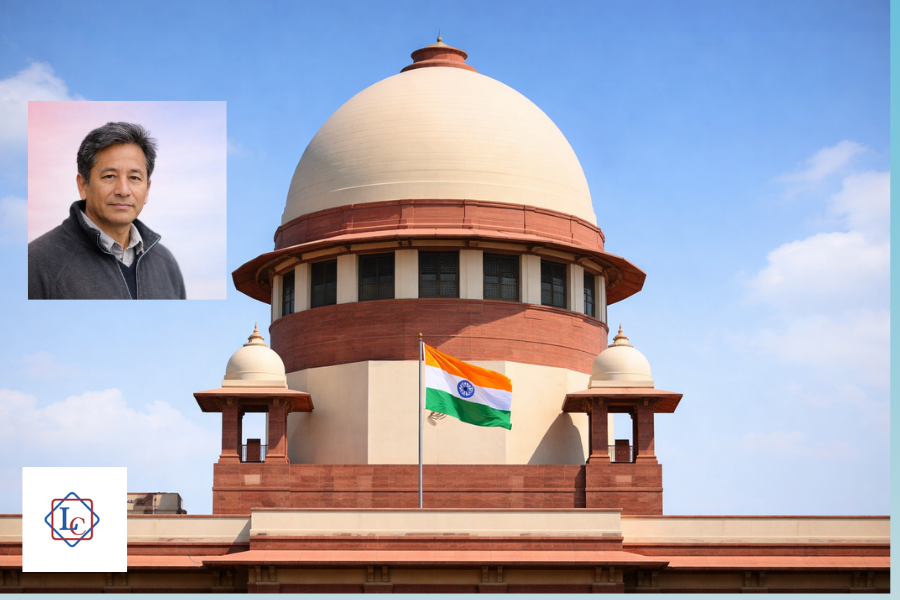
The Supreme Court disposed of the habeas corpus petition filed by Dr Gitanjali Angmo challenging Ladakh activist Sonam Wangchuk’s detention under the National Security Act, holding the plea had become infructuous after the Central government revoked the detention on March 14. Senior Advocate Kapil Sibal’s request to keep the matter pending was declined.
THE Supreme Court, today, disposed of the habeas corpus petition challenging the detention of Ladakh activist Sonam Wangchuk under the National Security Act, 1980, holding that the plea had become infructuous after the Central government revoked his detention order on March 14.
A Bench of Justice Aravind Kumar and Justice P.B. Varale observed that nothing was left in the matter to decide.
The petition had been filed by Wangchuk’s wife, Dr Gitanjali Angmo, through Advocate on Record Dr Sarvam Ritam Khare, seeking a declaration that his preventive detention was illegal.
The case, listed as Gitanjali J. Angmo v. Union of India and Ors (W.P.(Crl.) No. 399/2025), had been heard across multiple dates since October 2025, during which the Court raised several pointed questions about the legality and procedural propriety of the detention.
When the matter came up on Monday, Senior Advocate Kapil Sibal, appearing for Angmo, sought posting of the case after the Ram Navami vacation, pressing for a hearing on the merits of the detention order even though Wangchuk had already been released. The Bench, however, was not inclined to agree.
Also read: Grant of bail must rest on merits, not on monetary deposits, Supreme Court reiterates
“No, what is left (to decide)?” the Bench asked. Solicitor General Tushar Mehta, appearing for the Union, urged that the matter be closed, telling the Court that he would “request Mr. Sibal to let it be.”
The Court then proceeded to pass an order disposing of the petition. It recorded that, “the order impugned having got spent itself, or in other words, the order of detention having been revoked, the prayer sought for in the petition has become infructuous.”
Wangchuk had been detained on September 26, 2025, by the District Magistrate of Leh under section 3(2) of the NSA, following violent protests in Leh over demands for statehood and Sixth Schedule status for the Union Territory of Ladakh.
The protests on September 24 had left four people dead and over 90 injured. He was subsequently lodged in Jodhpur Central Jail in Rajasthan.
During the pendency of the case, a central dispute that emerged was whether the materials forming the basis of the detention order had been fully supplied to Wangchuk.
Sibal had argued that four videos dated September 24, which the administration claimed contained inflammatory speeches, were never given to the activist, depriving him of his right to make an effective representation under Article 22(5) of the Constitution.
The administration had maintained that a pen drive containing the videos was handed over to Wangchuk, and that a senior police officer had personally gone through the contents with him. The Court, however, had questioned whether the activist had actually had an opportunity to view the recordings while in custody.
The Bench had also flagged discrepancies in the translations of Wangchuk’s speeches submitted by the Centre, noting that a three-minute speech had been rendered as a seven-to-eight-minute transcript. The Court had observed that translations must be precise, especially in the age of artificial intelligence, and asked the Solicitor General to address these errors.
On the substance of the speeches themselves, the Court had remarked that the Centre was “reading too much into” Wangchuk’s statements.
When Additional Solicitor General KM Nataraj submitted that the activist had warned of violent agitation similar to Nepal, Justice Varale had observed that Wangchuk appeared to be expressing concern about youth abandoning Gandhian peaceful methods, rather than inciting violence.
The Centre, for its part, had characterised the speeches as calls for secessionist activity. Solicitor General Mehta had told the Court during earlier hearings that Wangchuk’s references to the Arab Spring, Bangladesh and Nepal amounted to an attempt to bring about a similar upheaval in Ladakh, a sensitive border area.
The government had also alleged that the activist had instigated the youth to self-immolate and incited them to create riot-like situations.
The Court had earlier urged the Centre to consider releasing Wangchuk on health grounds, after medical reports indicated his condition was deteriorating during his time in Jodhpur Central Jail.
However, the Centre had declined, with Mehta submitting that the activist was “fit, hale and hearty” and that no exceptions could be made in preventive detention matters.
The case had been adjourned multiple times in February and March after the Solicitor General was either unavailable or sought time to address the transcript discrepancies flagged by the Court.
On March 10, the Bench had indicated it would go through the videos cited by the Centre during the Holi vacation and complete the hearing by March 17.
Before that hearing could take place, the government announced the revocation of the detention on March 14, noting that Wangchuk had already served nearly half of the maximum period of preventive detention permitted under the NSA.
The revocation order came at a point when the case appeared to be approaching a legally consequential stage, with the Court having examined procedural fairness, the accuracy of translated transcripts, and the nexus between Wangchuk’s speeches and the violence that followed.


Leave a Reply