
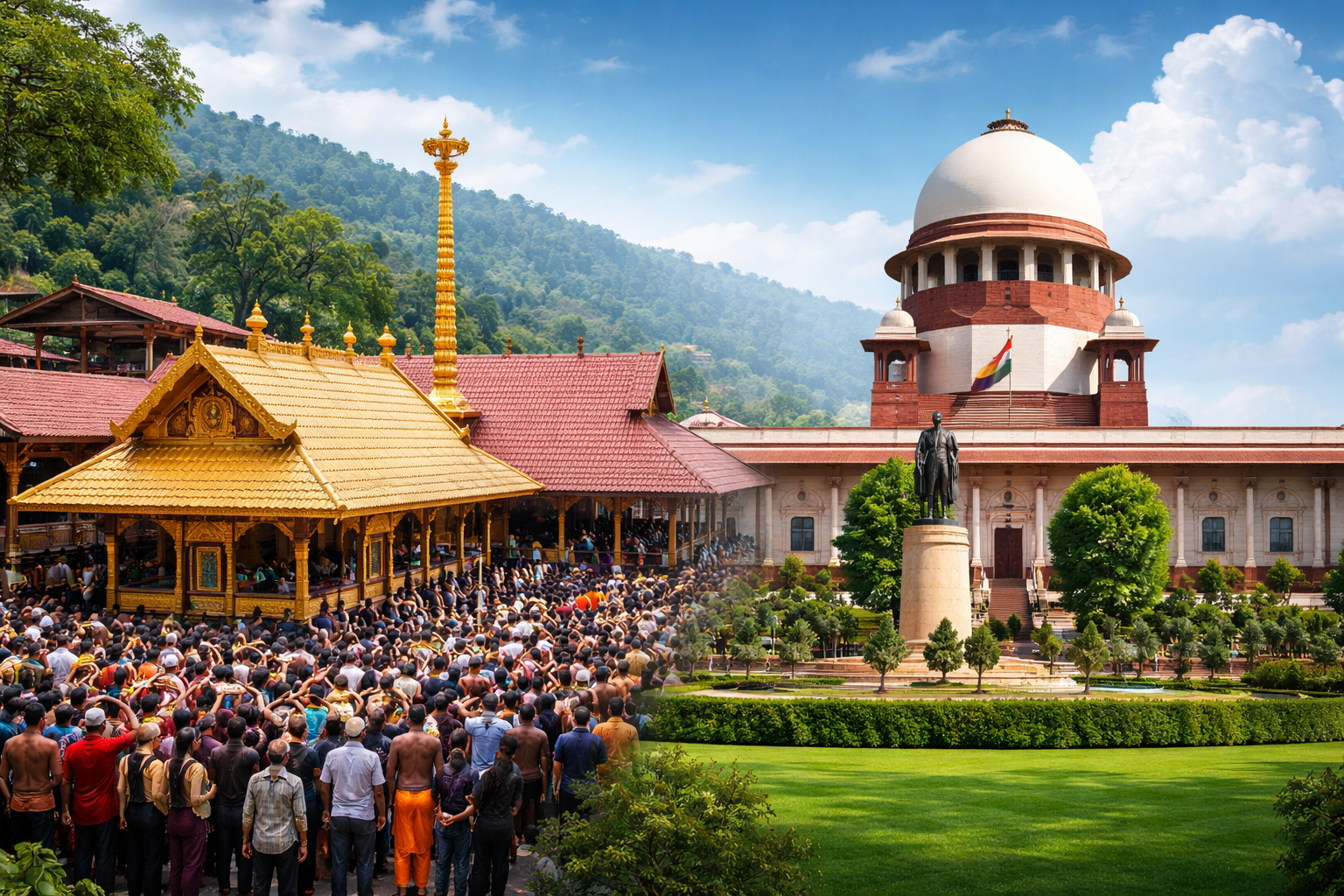
The Supreme Court has scheduled hearings before a nine-judge Constitution Bench from April 7, 2026, to decide the long-pending Sabarimala temple entry review. The Central Government has declared its support for the review petitions challenging the 2018 verdict that permitted women of all ages to enter the Kerala shrine.
Report:
The Supreme Court on Monday directed that a nine-judge Constitution Bench will commence hearings in the Sabarimala temple entry review from April 7, 2026, finally setting in motion a case that has remained in constitutional limbo for over six years.
A Bench comprising Chief Justice Surya Kant, Justice Joymalya Bagchi, and Justice Vipul M Pancholi passed the order, with hearings expected to conclude by April 22.
During the hearing, Solicitor General Tushar Mehta, appearing for the Central Government, informed the Court that, “We are supporting the review.” Senior Advocate C.S. Vaidyanathan also expressed support for the review petitions. On the other side, Senior Advocates Abhishek Manu Singhvi and Maneka Guruswamy appeared for the original writ petitioners who support women’s entry into the temple, while Senior Advocate Jaideep Gupta represented the State of Kerala.
The Court appointed Krishna Kumar Singh as nodal counsel for the review petitioners and Shashwati Pari as nodal counsel for those opposing the review. Senior Advocate K. Parameshwar, along with Advocate Shivam Singh, has been appointed as amicus curiae to assist the Court.
As per the schedule fixed by the Court, parties supporting the review will present arguments from April 7 to 9, those opposing the review will be heard from April 14 to 16, and rejoinder submissions will take place on April 21. The final submissions by the amicus curiae are expected to conclude by April 22.
The Court directed all parties to file their written submissions on or before March 14, 2026. The composition of the nine-judge Constitution Bench will be notified separately by the Chief Justice through an administrative order.
Background of the Sabarimala temple dispute
The Sabarimala Sree Dharma Sastha Temple, nestled within the Periyar Tiger Reserve in the Western Ghats of Kerala’s Pathanamthitta district, is one of the most revered pilgrimage sites in India, which attracts millions of devotees annually. The temple is dedicated to Lord Ayyappa, who is considered a celibate deity. Devotees traditionally undertake a 41-day penance, renouncing worldly pleasures, before visiting the shrine.
For centuries, women of ‘menstruating age,’ broadly defined as those between 10 and 50 years, were prohibited from entering the temple to protect the deity’s celibacy. According to the Memoir of the Survey of the Travancore and Cochin States completed in 1820, the restriction was already in place at that time, with the survey noting that old women and young girls could approach the temple but those who had attained puberty were forbidden entry.
Also read: Supreme Court expresses dissatisfaction over FSSAI’s front-of-package labelling delays
The exclusion was first challenged legally in 1990 when one S. Mahendran filed a complaint before the Kerala High Court after observing that women were allegedly entering the temple for ceremonial purposes such as the first rice-feeding ceremony of children.
The Kerala High Court, in S. Mahendran v. The Secretary, Travancore Devaswom Board (1991), upheld the restriction, ruling that the exclusion was constitutional and justified as a long-standing custom. The high court held that the practice did not violate women devotees’ rights to equality under Article 14 or freedom of worship under Article 25 of the Constitution. The restriction was also protected by Rule 3(b) of the Kerala Hindu Places of Public Worship (Authorisation of Entry) Rules, 1965.
In 2006, the Indian Young Lawyers Association filed a public interest litigation before the Supreme Court challenging the temple’s prohibition on women.
The State of Kerala, which had initially supported the restriction, later changed its stance and submitted that women should be allowed entry. After the matter was referred to a three-judge Bench in 2008 and subsequently to a five-judge Constitution Bench in 2017, the Court heard arguments on whether the prohibition violated fundamental rights.
On September 28, 2018, a five-judge Constitution Bench headed by then Chief Justice Dipak Misra delivered a landmark judgment in Indian Young Lawyers Association v. State of Kerala, ruling by a 4:1 majority that the exclusion of women was unconstitutional.
The majority, comprising Chief Justice Misra, Justices R.F. Nariman, A.M. Khanwilkar, and D.Y. Chandrachud, held that the practice violated women’s fundamental rights under Articles 14, 15, and 25 of the Constitution. The Court struck down Rule 3(b) of the Kerala Hindu Places of Public Worship (Authorisation of Entry) Rules, 1965, and held that Lord Ayyappa devotees do not constitute a separate religious denomination entitled to protection under Article 26.
Justice Indu Malhotra, the lone woman on the Bench, dissented, holding that issues of deep religious sentiment should not ordinarily be interfered with by courts. She observed that the doctrine of equality should not be permitted to override the fundamental right to worship as per the tenets of one’s religion.
The verdict triggered widespread protests across Kerala. Devotees and political parties organised demonstrations demanding protection of traditional customs. When the temple opened on October 17, 2018, for the first time after the verdict, massive protests ensued. Several women attempted to enter the shrine but were forced to turn back by mobs of protesters who blocked paths, pelted stones, and vandalised vehicles.
On January 2, 2019, two women, Bindu Ammini (aged 40), a law lecturer and Dalit activist, and Kanakadurga (aged 39), a government employee, entered the temple under police protection in the early hours of the morning, becoming the first women of menstruating age to do so following the Supreme Court verdict.
Their entry sparked statewide protests, and the temple was closed for a purification ritual. One person died in the ensuing violence, and thousands were arrested. Both women were forced into hiding and faced sustained threats and attacks.
The Kerala Government later informed the Supreme Court that 51 women had entered the temple following the verdict.
More than 60 review petitions were subsequently filed by devotees, religious groups, and organisations, including the National Ayyappa Devotees (Women’s) Association, the Nair Service Society, and the All Kerala Brahmin’s Association, challenging the 2018 verdict.
The petitioners argued that the Court had interfered with essential religious practices and that Lord Ayyappa devotees constitute a separate religious denomination.
On November 14, 2019, a five-judge Bench headed by then Chief Justice Ranjan Gogoi, by a 3:2 majority, decided to keep the review petitions pending and referred certain overarching constitutional questions to a larger Bench.
The majority comprising Chief Justice Gogoi, Justice A.M. Khanwilkar, and Justice Indu Malhotra observed that issues in the Sabarimala review were common to pending cases concerning Muslim women’s entry into mosques and dargahs, the entry of Parsi women married to non-Parsi men into fire temples, and the validity of the practice of female genital mutilation in the Dawoodi Bohra community.
Justices D.Y. Chandrachud and R.F. Nariman dissented, noting that the issues concerning Parsi and Muslim women were not before the original Sabarimala Bench and ought not to have been tagged.
In January 2020, a nine-judge Constitution Bench was notified, comprising then Chief Justice S.A. Bobde, Justices R. Banumathi, Ashok Bhushan, L. Nageshwara Rao, Mohan M. Shantanagoudar, S. Abdul Nazeer, R. Subhash Reddy, B.R. Gavai, and Surya Kant (now Chief Justice).
In February 2020, the nine-judge Bench held that the reference was maintainable and that questions of law could be referred to a larger Bench even during review proceedings.
The Bench framed seven questions of law for consideration, including the scope of religious freedom under Article 25, the interplay between individual rights under Article 25 and denominational rights under Article 26, and whether a person not belonging to a religious denomination can question its practices through a PIL.
The matter was subsequently delayed due to the Covid-19 pandemic and remained in cold storage for years. In February 2023, a Constitution Bench referred the question of the validity of excommunication practices among the Dawoodi Bohras to the same nine-judge Bench.
Monday’s order brings the long-pending matter back on track. The nine-judge Bench’s decision will not only determine the fate of the Sabarimala review petitions but will also have far-reaching implications for the pending cases concerning women’s access to religious institutions across faiths.
Case Title: Kantaru Rajeevaru v. Indian Young Lawyers Association [R.P.(C) No. 3358/2018 in W.P.(C) No. 373/2006]


Leave a Reply