
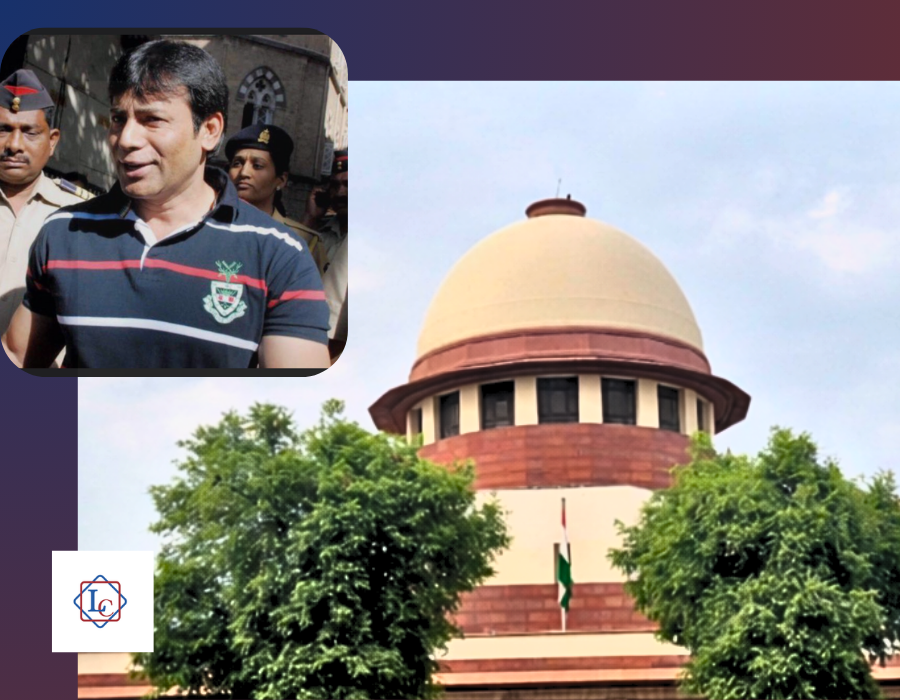
The Supreme Court rejected 1993 Bombay blasts convict Abu Salem’s application seeking premature release on grounds that he had completed 25 years of imprisonment. The Court granted him liberty to pursue remedies before the Bombay High Court.
Report:
The Supreme Court on February 16 dismissed an application filed by gangster Abu Salem, who had sought premature release from prison claiming he had completed 25 years of imprisonment in accordance with an extradition treaty between India and Portugal.
A Bench of Justices Vikram Nath and Sandeep Mehta declined to grant any interim relief and directed Salem to pursue his remedies before the Bombay High Court, which is already seized of the matter.
Salem, convicted under the Terrorist and Disruptive Activities (Prevention) Act for his role in the 1993 Bombay serial blasts, had filed the application claiming the benefit of three years and 16 days of jail-earned remission for good conduct.
His counsel, Senior Advocate Rishi Malhotra, argued that when this remission is added to his actual custody period, Salem has crossed the 25-year mark and any further detention amounts to illegal custody.
Malhotra produced Rule 4 of the Maharashtra Prisons (Remission System) Rules, 1962, which deals with different kinds of remission, and submitted that his client was seeking ordinary and annual good conduct remission. He contended that he had surpassed 10 months and that it is the case of habeas corpus, thus illegal custody.
The State of Maharashtra, however, maintained that Salem has not completed 25 years. An affidavit filed by the Inspector General of Prisons and Correctional Services before the Bombay High Court had stated that till March 31, 2025, Salem had only completed 19 years, 5 months and 18 days of his prison term. Malhotra described this calculation as an “arithmetical error.”
Justice Nath observed that whether the affidavit filed by prison authorities is correct or not will have to be considered by the High Court, and the Supreme Court cannot be expected to bear the burden of the High Courts in pending cases. When Malhotra pressed again that Salem is undergoing illegal custody for more than 10 months, Justice Nath reminded him of the nature of his conviction by saying that, “You have stayed for 25 years for not doing something good to the society. You have [been] convicted under TADA.”
The petition was ultimately dismissed as withdrawn, with the Court ordering that, “Mr Rishi Malhotra, learned senior counsel, after arguing for sometime states that this petition may be dismissed as withdrawn, leaving it open for the petitioner to go before the High Court for an early hearing and disposal of the pending matter. Petition is dismissed with liberty.”
Salem had earlier approached the Bombay High Court seeking a direction for authorities to specify a release date after completing 25 years. He contended that his right to life and liberty under Article 21 of the Constitution was being breached since he was being kept in prison beyond the 25-year jail term agreed upon by Indian authorities while signing the extradition treaty with Portugal. The High Court in July 2025 prima facie observed that Salem had not completed 25 years, referring to the Supreme Court’s 2022 order which reckoned the date of Salem’s arrest as October 12, 2005.
Also read: Supreme Court expresses dissatisfaction over FSSAI’s front-of-package labelling delays
The core dispute centres on how the 25-year period should be calculated. According to Salem’s calculation, his undertrial custody from November 2005 till September 2017 amounted to approximately 11 years, 9 months and 26 days. His post-conviction custody from February 2015 to December 2024 added another 9 years, 10 months and 4 days. Adding the remission earned for good behaviour, Salem claimed he had effectively served more than 25 years. Maharashtra authorities dispute this arithmetic, and the question of whether remission can even be granted to convicts under TADA remains a live issue before the High Court.
Background
Abu Salem Abdul Qayoom Ansari was a key figure in the Dawood Ibrahim crime syndicate and played a pivotal role in the 1993 Bombay serial bomb blasts, one of India’s deadliest terror attacks. On March 12, 1993, twelve bombs exploded at different locations across Mumbai, killing 257 people, injuring over 700, and causing property damage worth Rs 23 crore. The prosecution established that the conspiracy was hatched in Dubai to avenge the demolition of the Babri Masjid on December 6, 1992. Salem’s role involved transporting and distributing arms and ammunition used in the blasts, including AK-56 rifles.
Salem fled India and was eventually arrested in Lisbon, Portugal, on September 18, 2002, along with actress Monica Bedi. A prolonged extradition battle ensued, during which the Government of India, through then Deputy Prime Minister LK Advani, provided a sovereign assurance to Portugal on December 17, 2002. The assurance stated that Salem would not be given the death penalty or imprisoned for a term beyond 25 years, in accordance with Portuguese law which does not permit life imprisonment. After examination by the Court of Appeals in Lisbon, the Supreme Court of Justice of Portugal, and the Constitutional Court of Portugal, extradition was granted in eight criminal cases. Salem was handed over to Indian authorities on November 10, 2005.
Following his extradition, Salem challenged the framing of additional charges against him beyond those specified in the Portuguese extradition decree. In September 2010, the Supreme Court dismissed his appeals, holding that he could be tried for ‘lesser offences’ disclosed by the same facts proved for securing his extradition under Section 21 of the Extradition Act, 1962.
In June 2017, a Special TADA Court found Salem and five others guilty of conspiring and carrying out the blasts. He was convicted under Sections 120B, 302, 307, 326, 427, 435,436, 201 and 212 of the Indian Penal Code, Sections 3, 3(3), 5 and 6 of the TADA, and provisions of the Arms Act, Explosive Substances Act and the Prevention of Damage to Public Property Act. In September 2017, Salem was sentenced to life imprisonment.
Separately, in February 2015, he had been sentenced to life imprisonment in another case by TADA court for the murder of Mumbai builder Pradeep Jain.
In July 2022, the Supreme Court, in a landmark ruling in Abu Salem Abdul Qayoom Ansari v. State of Maharashtra, held that the Central Government was bound to honour the sovereign assurance given to Portugal. Justices Sanjay Kishan Kaul and MM Sundresh directed that upon Salem completing 25 years, the Centre must advise the President of India for exercise of powers under Article 72 of the Constitution or itself exercise powers under Sections 432 and 433 of the Code of Criminal Procedure within one month of completion of that period. The Court, however, clarified that Salem’s detention period would begin from October 2005 and not from September 2002 when he was arrested in Portugal on a separate passport fraud charge.
The current litigation turns on whether jail-earned remission can be counted towards the 25-year period for a TADA convict, and whether Salem’s calculation of his custody period is accurate. With Sunday’s order, the matter now returns to the Bombay High Court for final adjudication.
Case Title: Abu Salem Abdul Qayoom Ansari v. The State of Maharashtra and Ors., Diary No. 60531-2025


Leave a Reply