
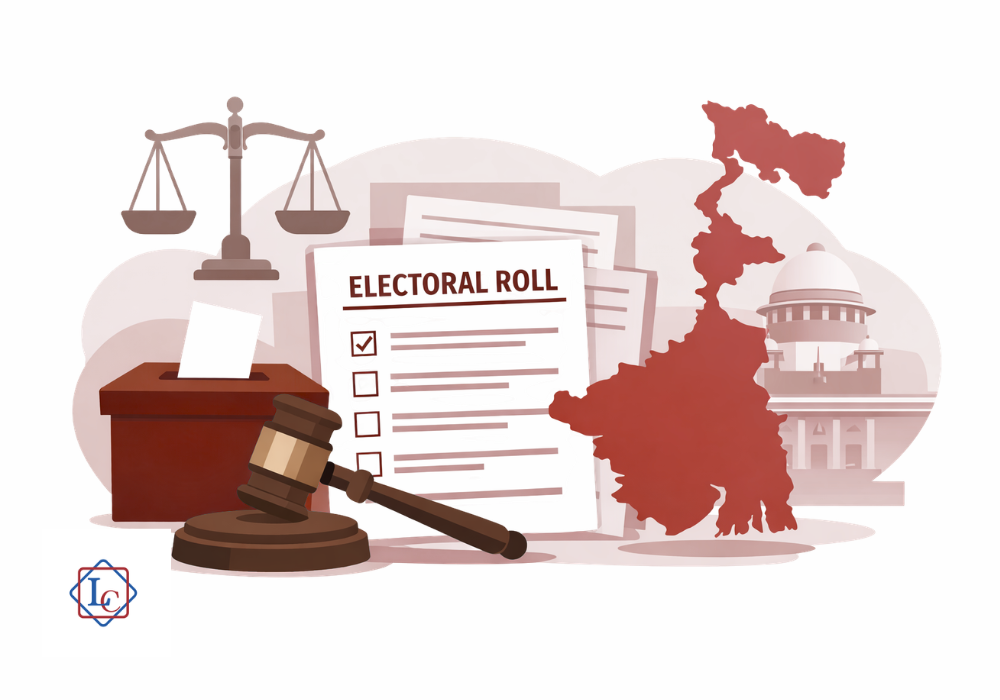
The Special Intensive Revision of electoral rolls in West Bengal has led to a dispute between the State government and the Election Commission of India. The Supreme Court has issued multiple directions, including deployment of judicial officers from three states to adjudicate approximately 80 lakh voter claims.
The Supreme Court has directed the deployment of judicial officers to adjudicate claims and objections in the Special Intensive Revision (SIR) of electoral rolls in West Bengal. The directions came after the Court noted what it termed a “trust deficit” between the West Bengal government and the Election Commission of India (ECI).
The ECI announced on October 27, 2025 that an intensive door-to-door verification exercise would be conducted across several states, including West Bengal, ahead of the 2026 Assembly elections. The exercise commenced on November 4, 2025. A draft electoral roll was published on December 16, 2025, with the final roll originally scheduled for publication on February 14, 2026.
At the time of the announcement, West Bengal had 7.66 crore registered voters. The ECI issued approximately 1.40 crore notices for document verification. These notices were categorised into three groups: mapped voters linked with the 2002 SIR, unmapped voters not linked with the 2002 SIR, and those falling under the “logical discrepancy” category, which comprised approximately 1.36 crore voters.
The “logical discrepancy” category included cases involving mismatch of father’s name, mismatch of parents’ ages, difference in parents’ ages of more than 50 years, difference in grandparents’ ages of less than 40 years, and voters shown as having other similar discrepancies.
More than 58 lakh names were removed from the initial list of 7.66 crore voters, including those who were dead, absent, duplicate, or missing. The number of voters in the draft list published in December 2025 stood at 7.08 crore.
On January 3, 2026, Chief Minister Mamata Banerjee wrote to Chief Election Commissioner Gyanesh Kumar. In the letter, Banerjee described the SIR as “arbitrary and flawed” and accused the Commission of presiding over an “unplanned, ill-prepared and ad hoc” exercise.
The ECI maintained it was discharging its “constitutional duty” under Article 326 of the Constitution, which provides for universal adult suffrage and states that every person who is a citizen of India and is not less than 18 years of age shall be entitled to be registered as a voter.
Trinamool Congress Members of Parliament Derek O’Brien and Dola Sen filed petitions challenging the SIR process. On January 12, 2026, a Bench led by Chief Justice Surya Kant sought the ECI’s response. The Court observed that, “See the strain and stress going on for ordinary people. Over one crore people have been issued notices…we are going to pass some orders.” [Source:
On January 19, 2026, a three-judge Bench comprising Chief Justice Surya Kant, Justice Dipankar Datta, and Justice Joymalya Bagchi issued directions in Mostari Banu v. Election Commission of India (2026). The Court directed that names in the “logical discrepancy” list be displayed at panchayat offices. It permitted authorised representatives to attend hearings on behalf of voters and granted a ten-day extension beyond the original deadline.
On January 28, 2026, Chief Minister Banerjee filed a writ petition under Article 32 of the Constitution in her personal capacity. The petition, registered as W.P.(C) No. 129/2026, named the ECI and the West Bengal Chief Electoral Officer as respondents. It sought the quashing of all SIR-related orders issued on June 24, 2025 and October 27, 2025, and prayed that the 2026 Assembly elections be conducted on the basis of the existing 2025 electoral rolls.
Banerjee also filed an interlocutory application seeking permission to appear and argue in person. Banerjee, who holds a law degree from Jogesh Chandra Choudhury College of Law, Calcutta, had last practised as an advocate in 2003.
On February 4, 2026, the matter was heard by a Bench comprising Chief Justice Surya Kant, Justice Joymalya Bagchi, and Justice NV Anjaria. Banerjee, seated in Courtroom 1 alongside Senior Advocates Kapil Sibal and Shyam Divan, was permitted to supplement her counsel’s submissions.
Banerjee contended that West Bengal was being “targeted” by the SIR process and questioned why similar exercises were not being conducted in Assam or the Northeast. She alleged that the revision was designed for deletion rather than inclusion, citing instances of women whose names had been struck off after changing surnames following marriage, and of living persons mistakenly declared dead. She stated that over 100 people, including Booth Level Officers, had died during the exercise.
Banerjee also raised concerns regarding the appointment of approximately 8,000 micro-observers from BJP-ruled states. She described the Election Commission as a “WhatsApp Commission” that issued informal instructions rather than formal orders.
Senior Advocate Rakesh Dwivedi, appearing for the ECI, submitted that micro-observers had been appointed because the State government had failed to provide sufficient Group B officers despite repeated reminders.
Solicitor General Tushar Mehta, appearing for the Union, alleged that there was an “atmosphere of hostility” towards ECI officials in West Bengal.
The ECI filed an affidavit on February 6, 2026 stating that the SIR process had been hampered by lack of cooperation from the state administration, including the police, and by instances of intimidation and obstruction faced by election officials on the ground. The ECI alleged that despite repeated requests, adequate officers were not provided by the state government.
On February 9, 2026, the Supreme Court stated that it would not permit impediments to the SIR exercise. Chief Justice Surya Kant stated that, “Whatever orders or clarifications are required, we will issue. But we will not allow any impediment to the SIR process. This must be understood.”
On February 20, 2026, a Bench comprising Chief Justice Surya Kant, Justice Joymalya Bagchi, and Justice Vipul M. Pancholi noted that, “There is an unfortunate allegation/counter-allegation which clearly depicts trust deficit between two constitutional functionaries — democratically elected state government and ECI.”
The Court stated that, “In order to ensure fairness in adjudication of genuineness of documents submitted and consequent inclusion or exclusion in voter list, we are left with hardly any other option but to request the Chief Justice of the High Court of Calcutta to spare some serving judicial officers along with some former judicial officers.”
The Court directed that each judicial officer shall be assisted by micro-observers from the ECI and by officers of the State government who have been deputed for such duties. The Court also directed the District Collectors and Superintendents of Police to provide logistic support to the judicial officers for smooth completion of the pending process.
The deadline for publication of the final voter list was extended from February 14 to 28.
On February 24, 2026, the Chief Justice of the Calcutta High Court informed the Supreme Court that approximately 80 lakh applications required adjudication. The Calcutta High Court stated that with only 250 judicial officers, primarily District Judges and Additional District Judges, currently engaged in the exercise, the process would take approximately 80 days to conclude if each officer disposed of 250 matters daily.
The Supreme Court then permitted the Chief Justice of the Calcutta High Court to requisition judicial officers from the neighbouring States of Jharkhand and Odisha. The Court also permitted Civil Judges (Senior Division) and Civil Judges (Junior Division) with service experience of not less than three years to participate in the process.
The Court directed that the travel, honorarium, and other expenses of judicial officers from Jharkhand and Odisha shall be borne by the ECI.
The Court specified that twelve documents specified in the ECI notifications dated October 27, 2025 read with June 24, 2025 shall be considered for verification. Additionally, the Court stated that Aadhaar as proof of identity and Madhyamik (Class 10) Admit Cards shall also be treated as valid documents.
Invoking its powers under Article 142, the Court directed that the final list shall be published on February 28, 2026, to be followed by publication of supplementary lists. The Court directed that all supplementary lists shall be “deemed” to have been published on February 28, 2026.
On February 25, 2026, the Court issued further clarifications. The Court directed that all documents referred to in paragraph 3(iii) of the 24 February order, which were received on or before February 14, 2026 but remained unuploaded, must be submitted to the presiding judicial officers by February 26, 2026, by 5 p.m. The Court also clarified that a Madhyamik (Class 10) Admit Card may be taken along with the Madhyamik Pass Certificate for the purpose of verifying the date of birth and parentage of the candidate.
Cases: (1)Mostari Banu v. The Elections Commission of India and Ors., W.P.(C) No. 1089/2025;
(2) Joy Goswami v. Election Commission of India and Anr., W.P.(C) No. 126/2026;
(3) Mamata Banerjee v. Election Commission of India and Anr., W.P.(C) No. 129/2026;
(4) Sanatani Sansad and Anr. v. Election Commission of India and Ors., W.P.(C) No. 1216/2025


Leave a Reply